
Counting the waves…
Counting the waves…

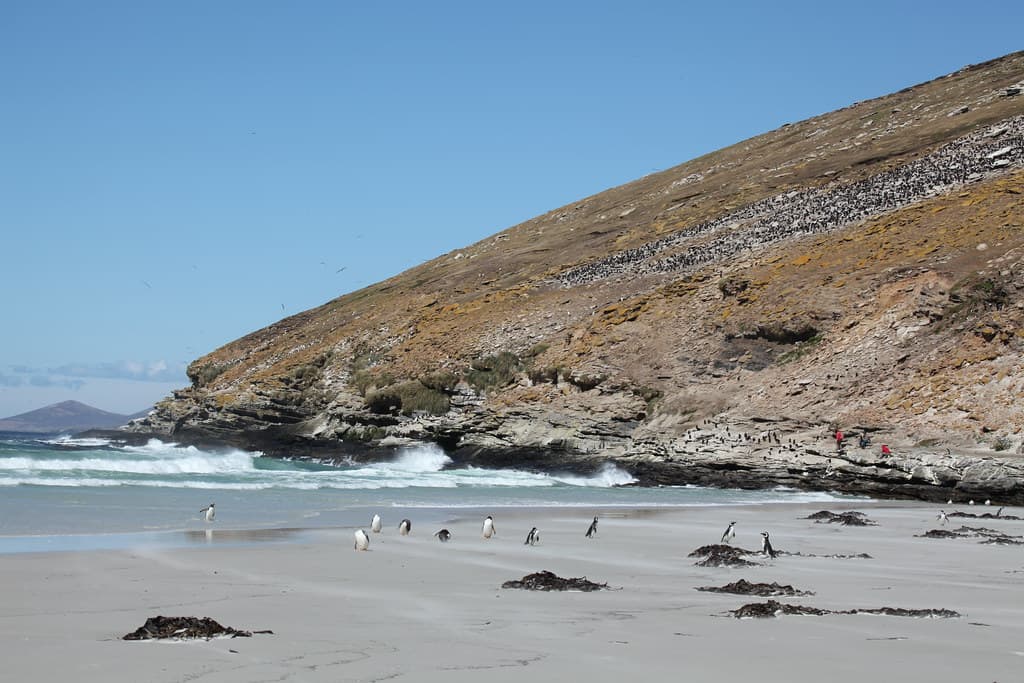
Saunders Island sits in the South Sandwich archipelago, a remote volcanic chain so far south that pack ice frames the horizon even in summer. You'll arrive only aboard expedition ships built for polar waters, and your time ashore will be measured in hours, not days. The beach stretches in a curve of dark pebbles beneath cliffs striped with volcanic ash, where steam vents still whisper of the island's restless geology. The shoreline belongs to chinstrap and gentoo penguins, whose rookeries sprawl across the slopes in raucous, guano-streaked colonies. Elephant seals haul out on the cobbles, their bulk spilling over stones smoothed by the Weddell Sea's relentless churn. You'll feel the wind—a constant companion here—pressing against your expedition parka as waves the color of slate roll in with metronomic precision. This is not a beach for swimming or sunbathing. It's a shore that demands reverence, where you stand at the edge of the world's wildest ocean and watch seabirds wheel above waters few humans will ever see. The pebbles beneath your feet have been tumbled by storms that cross an entire ocean without meeting land, and the silence between gusts feels older than continents.
Places, rentals, tours and events within walking and driving distance of Saunders Island Beach.
Photos
Swimming at Saunders Island Beach is extremely dangerous and strongly discouraged. The sub-Antarctic waters surrounding this volcanic island remain near freezing year-round, posing immediate hypothermia risk. The pebble beach can be unstable with strong wave action and unpredictable currents. Volcanic terrain may include sharp rocks and unstable ground. With no emergency services or medical facilities anywhere nearby, any accident could become life-threatening. Visitors arriving on expedition cruises must adhere to strict safety guidelines and remain under professional supervision at all times during shore visits.
The optimal visiting window for Saunders Island Beach is during the austral summer, particularly December through February, when weather conditions are marginally more favorable and daylight hours are longest. Even during summer, temperatures remain cold and weather patterns are highly volatile in the South Sandwich Islands. Sea ice conditions improve during these months, allowing expedition vessels better access. Wildlife viewing opportunities, including seabirds and marine mammals, are also enhanced during the breeding season. However, all visits remain entirely weather-dependent with no guaranteed landings possible.
Reaching Saunders Island Beach requires participation in a specialized expedition cruise focused on the sub-Antarctic islands, departing from ports in South America or the Falkland Islands. The South Sandwich Islands are among the world's most remote island chains, requiring vessels equipped for extreme open-ocean navigation and ice conditions. Actual beach landings use Zodiac inflatable boats and are only attempted when weather and sea conditions permit. These voyages typically last two to three weeks and must be booked through licensed Antarctic tour operators experienced in extreme-environment travel.
Saunders Island Beach has absolutely no infrastructure, facilities, or services of any kind. The island is uninhabited with no research stations, shelters, or human presence. All visitors are part of expedition cruises and remain based on their ships, which provide all accommodation, meals, and necessary amenities. Shore excursions are brief, typically lasting only a few hours depending on conditions. Travelers must bring all required supplies, safety equipment, and provisions aboard the expedition vessel, as no resources are available on the island itself.
Saunders Island Beach is distinguished by its location in the exceptionally remote South Sandwich Islands, a volcanic arc rarely visited even by Antarctic expedition standards. The dramatic volcanic terrain creates striking black pebble beaches contrasting with ice and ocean. Active geothermal features may be visible in the area, showcasing ongoing volcanic processes. The island hosts important seabird colonies in pristine habitat with minimal human impact. Its extreme isolation and expedition-only access make it one of Earth's most exclusive coastal destinations, visited by perhaps only hundreds of people ever.