Counting the waves…
Counting the waves…
A refined fusion of water purity, environmental stability, and communal vibrancy for Playa San Sebastián Norte.
View MethodologyAnalyzed via live sensors and environmental data.
Wave height, wind, and atmospheric stability.
Live footfall and crowd balance metrics.
Community reviews and curated sentiment.
“You'll cross an international border to find this bay where kelp geese patrol the wrack line and low tide unveils kilometers of ribbed sand. The Andes fade into memory as the steppe meets the sea.”
Limited recent visitor reports — live OBI telemetry is your best guide for current conditions.
The gravel highway from Chile deposits you at a beach where geography reshapes itself twice daily. At low tide, the bay empties into glistening mudflats that reflect the scudding clouds, transforming San Sebastián into a vast mirror bordered by golden grasses. Shorebirds—oystercatchers, plovers, southern lapwings—work the exposed substrate, their calls mixing with the constant Patagonian wind.
You'll walk across sand compacted hard as pavement, ridged with tidal patterns that hold rainwater in shallow pools. Driftwood from southern beech forests litters the upper beach, silvered by salt and sun. The water, when it returns, arrives in flat sheets rather than waves, the bay's shelter muting the Atlantic's usual temperament. Kelp tangles mark the high-tide line in dark, pungent rows.
 Credit: Unsplash
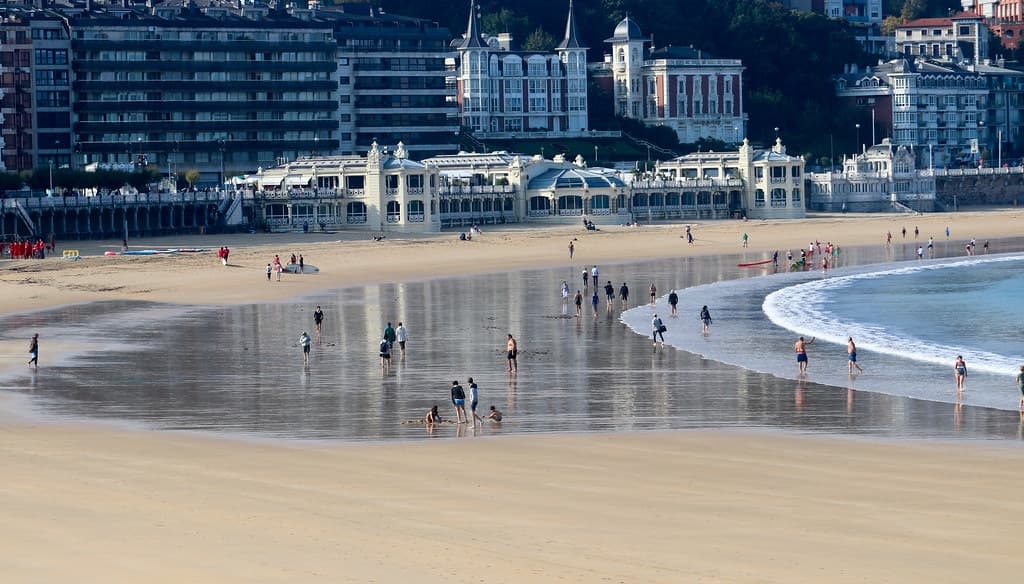
people on beach during daytime
 Credit: Unsplash
a beach with a sandy beach and trees
Capture the shifting flats
Walk the endless sand
Observe migrating shorebirds
Prime Visitation
Anytime | Less Crowds
Where it is
Playa San Sebastián Norte
San Sebastián, Tierra del Fuego, Argentina
-53.239800°, -68.258600°
Weather
Loading…
Swell
—
Temp
Warm · Restorative
UV Index
Moderate
Wind
—
Tidal State
Last known
Max Sunlight
—
Ideal Shade
—
Jan - Dec (Peak)
Mar - Nov (Off-season)
Anytime | Less Crowds
Select a category to load nearby places.
Unlock restaurants, luxury stays and curated maritime experiences within 2km
Playa San Sebastián Norte is relatively calm compared to open Atlantic beaches, making it more family-friendly for beach activities. However, the water remains very cold year-round, and swimming is not commonly practiced. The broad tidal flats are excellent for children to explore tide pools and observe coastal wildlife at low tide. Always supervise children closely, as tides can change quickly. The calm nature refers to wave action, but weather conditions can still be unpredictable. This beach is best enjoyed for walking, wildlife observation, and relaxed family outings rather than water sports.
The beach is accessible year-round with consistently fewer crowds due to its remote location. Summer months (December-February) offer the most comfortable temperatures and longest daylight hours for family visits. Low tide periods are particularly rewarding, revealing extensive tidal flats ideal for exploration and bird watching. The area experiences strong winds throughout the year, so windproof clothing is essential regardless of season. Early morning or late afternoon visits during summer provide beautiful light and wildlife activity. Plan your visit around tide schedules to maximize exploration of the exposed flats.
Playa San Sebastián Norte is located near the Chilean border crossing on Route 3, the main international highway connecting Argentina and Chile through Tierra del Fuego. From Río Grande, drive north approximately 90 kilometers toward the San Sebastián border. Access roads to the northern bay sector may be unpaved. A personal vehicle is necessary as public transportation is extremely limited. The proximity to the border crossing makes it accessible, but always carry identification, fuel, and supplies. Road conditions are generally decent along Route 3 but can deteriorate on beach access roads.
San Sebastián itself has minimal tourist infrastructure, with perhaps a small guesthouse or very basic services near the border crossing. Most visitors base themselves in Río Grande, about 90 kilometers south, which offers hotels, hostels, restaurants, and full amenities. The border area may have a small café or shop with limited hours. Plan to be self-sufficient, bringing food, water, and snacks for your beach visit. If crossing to/from Chile, you'll find more services in Porvenir (Chile) accessible by ferry. Always prepare for a day trip with necessary supplies.
This beach offers a unique combination of international frontier atmosphere and pristine natural tidal environments. The broad tidal flats are among the most extensive in Tierra del Fuego, creating otherworldly landscapes when exposed. It's an excellent location for observing migratory shorebirds and experiencing the remote Atlantic coast without venturing far from main roads. The northern sector provides different perspectives of San Sebastián Bay, with views toward both Argentina and Chile. Its position along the international route gives it historical significance as a crossing point in one of the world's most remote regions.
Photos