Counting the waves…
Counting the waves…
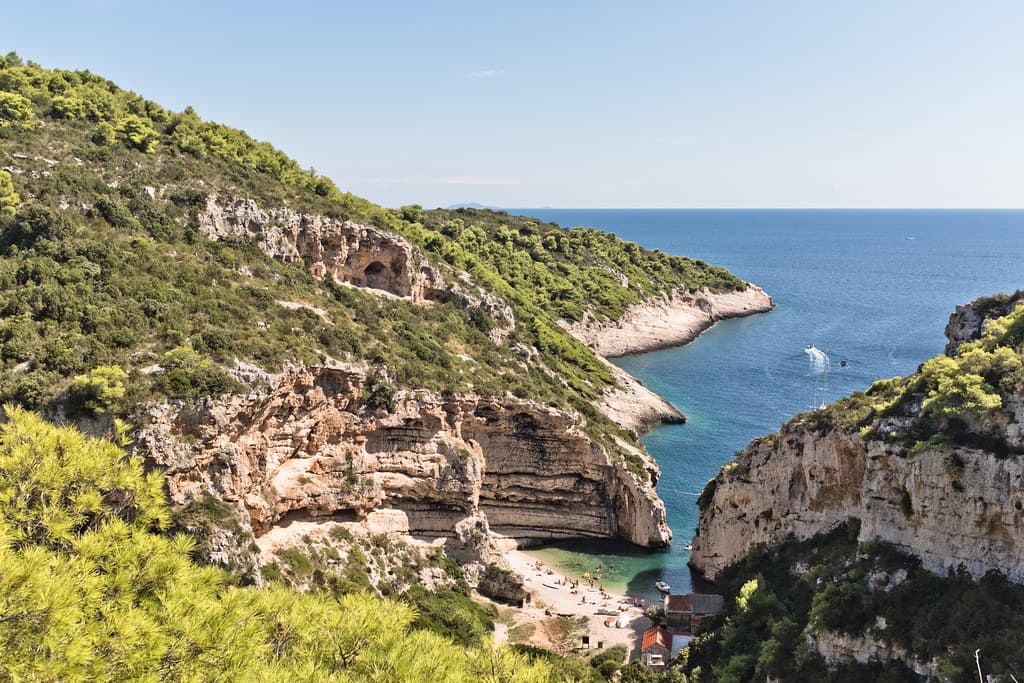
You switchback down a rocky trail that drops through scrub and wild rosemary, the sea appearing in fragments between limestone outcrops, until the path spills you onto a beach no wider than a city street. The cove's entrance is so narrow that sunlight penetrates for only a few hours each day, and the cliffs rise so abruptly that you feel you've stumbled into a coastal cathedral, its walls sculpted by millennia of wave action and weather. The pebbles underfoot range from egg-sized to nearly round, their surfaces worn smooth by the sea that surges through the gap with each swell. A handful of swimmers bob in the aquamarine channel, their strokes echoing off stone. Above you, tufts of Mediterranean scrub cling to fissures in the rock face, and swallows trace angular patterns against the sky. The beach accommodates perhaps fifty people comfortably; by midday in summer, that limit is tested. You came by boat taxi from Vis town or hiked the cliff path from the nearest road, so departure requires planning around the next shuttle or summoning energy for the climb. The inconvenience is deliberate. Stiniva rewards those willing to work for it, offering a geography so dramatic that photographs seem manipulated. You swim through the cleft toward open water, flanked by walls that compress the sea into shades of turquoise found nowhere else on the Dalmatian coast.
Places, rentals, tours and events within walking and driving distance of Stiniva Beach.
Photos
Swimming at Stiniva is generally safe in calm conditions, with clear waters and no strong currents. However, the beach is challenging for families with young children due to the steep rocky path down or boat-only access. The pebble shoreline drops off relatively quickly. During rougher seas or afternoon winds, waves can bounce off the narrow cliff walls, creating choppier conditions. There are no lifeguards on duty. The remote location means limited facilities, so bring water shoes for the pebbles and stay alert with children near the water.
Early morning or late afternoon during June or September offers the best balance of good weather and fewer visitors. July and August see peak crowds, with tour boats arriving mid-morning through early afternoon. The beach receives shade from the tall cliffs earlier in the evening, so visit before 4 PM for sunshine. Weekdays are quieter than weekends. Arriving by private boat or hiking down before 9 AM gives you the most peaceful experience. Weather is reliably warm and sunny from May through September in this region.
You can reach Stiniva by car, hiking, or boat. By car, drive about 8 km southeast from Vis Town toward the village of Žužeca, then park at the marked lot. A steep 15-20 minute hike down rocky switchbacks leads to the beach. Alternatively, join a boat tour or water taxi from Vis Town or Komiža (most common option). Private boat rentals offer flexibility. The hiking trail is challenging with loose rocks and requires good footwear. There's no direct public transport. Many visitors combine boat access with swimming directly into the cove.
Stiniva Beach itself has no facilities, restaurants, or accommodations due to its remote, protected nature. Visitors must bring their own food, water, and shade (umbrella). The nearest services are in the small village of Žužeca, roughly 2 km away by the access road, though options are very limited. For dining and lodging, stay in Vis Town (8 km) or Komiža (12 km), which offer hotels, apartments, restaurants, and shops. Plan as a half-day excursion and pack out all trash, as there are no bins on the beach.
Stiniva's dramatic geography makes it exceptional: a tiny pebble beach accessed through an extremely narrow gap between towering limestone cliffs, creating an almost hidden amphitheatre effect. The entrance from the sea is only about 4-5 meters wide, opening into a secluded cove. It was voted Europe's Best Beach in 2016. The vertical cliffs create stunning photo opportunities and give a sense of total seclusion. The turquoise water contrasts beautifully with white rock. This geological formation is rare and makes Stiniva one of Croatia's most Instagrammable and iconic beaches.