Counting the waves…
Counting the waves…
A refined fusion of water purity, environmental stability, and communal vibrancy for Plage de la Côte des Basques.
View MethodologyAnalyzed via live sensors and environmental data.
Wave height, wind, and atmospheric stability.
Live footfall and crowd balance metrics.
Community reviews and curated sentiment.
“You descend wooden stairs to find surf instructors waxing boards beside families staking out territory near the lifeguard tower. The tide pulls back to reveal tide pools trapped between striped sedimentary cliffs, while…”
Limited recent visitor reports — live OBI telemetry is your best guide for current conditions.
The wooden staircase deposits you onto ochre sand that stretches wide at low tide, narrow and urgent when the Atlantic reclaims its territory twice daily. Behind you, the layered rust-and-cream cliffs of the Côte des Basques rise like a geological textbook, each stratum a chapter in sixty million years of tectonic negotiation between continent and ocean. Surfers dot the lineup where gentle rollers reform over sandbars—this is where Basque surf culture took root in the 1950s, when californiens brought foam and fiberglass to France.
You time your visit to the falling tide, when the beach doubles in width and shallow pools appear, warm enough for toddlers to splash while their parents spread checkered blankets. By four o'clock, the light turns amber and photographers claim positions along the Promenade de la Côte des Basques above, tripods angled toward the horizon where the sun will drop behind the curve of the Bay of Biscay. The Villa Belza perches on its rocky outcrop to the north, a neo-medieval folly that anchors every sunset snapshot.
 Credit: Unsplash
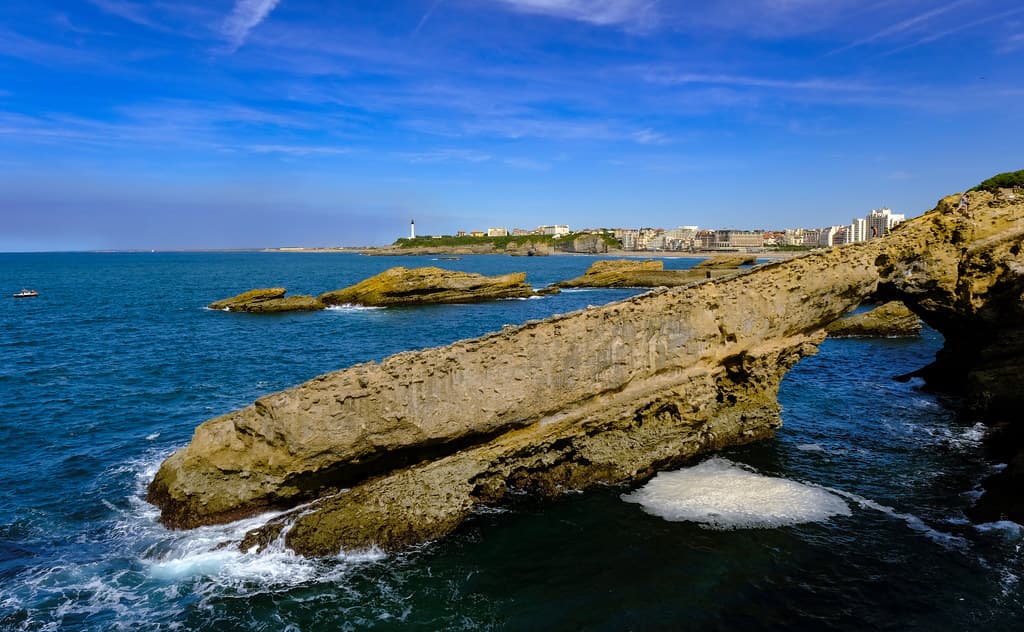
a view of a beach from a hill overlooking the ocean
 Credit: Unsplash
A view of a beach and ocean from a hill
Morning glass before wind picks up
Villa Belza framed by tide pools
Warm pools between sedimentary layers
Prime Visitation
surf session + cliffside sunset
Where it is
Plage de la Côte des Basques
Biarritz, Pyrénées-Atlantiques, France
43.475300°, -1.567500°
Weather
Loading…
Swell
—
Temp
Warm · Restorative
UV Index
Moderate
Wind
—
Tidal State
Last known
Max Sunlight
—
Ideal Shade
—
May - Sep (Peak)
Jan - Dec (Off-season)
surf session + cliffside sunset
Near Plage de la Côte des Basques
Explore dining, stays, nightlife, and activities near Plage de la Côte des Basques in Biarritz, France. Every listing below is a real place linked to this beach — open a card for reviews, maps, and booking options.
Food, cafés, and dining close to Plage de la Côte des Basques — curated from places linked to this beach.
Select a category to load nearby places.
Unlock restaurants, luxury stays and curated maritime experiences within 2km
Côte des Basques requires caution due to variable conditions. During high tide, the beach nearly disappears and currents strengthen significantly, making swimming dangerous. Low to mid-tide offers safer conditions with more sandy beach exposed. Lifeguards supervise during summer months, and you should always swim between flags when present. The beach is primarily known for surfing, and wave conditions can be powerful. Strong rip currents can develop, particularly near the rocky areas at either end. Check tide times before visiting, avoid high tide for swimming, and never swim outside supervised areas and hours.
For surfing, the beach works best at low to mid-tide when waves break over sand rather than rocks. Autumn and spring provide consistent swells for experienced surfers, while summer offers gentler conditions suitable for beginners and longboarders. The beach faces west-southwest, making it exceptional for sunset viewing year-round. Late afternoon visits combine surfing or beach time with spectacular sunset photography. Arrive 2-3 hours before sunset for optimal positioning. Summer evenings draw crowds for sunset sessions. Check tide schedules, as high tide leaves minimal beach space and dangerous conditions.
The beach is located south of central Biarritz, accessible via Avenue de la Marne or coastal paths. By car, follow signs toward Côte des Basques and use the parking area above the beach on Avenue Prince de Galles, though spaces fill quickly in summer. A long staircase descends the cliff from the parking area to beach level. Alternatively, walk along the scenic coastal path from Port Vieux or other central Biarritz beaches, approximately 15-20 minutes. Local buses serve the area during summer. Be prepared for the stair climb back up after your beach visit.
Facilities at Côte des Basques are more limited than at Grande Plage. Basic amenities include public restrooms and outdoor showers near the beach access stairs. A couple of seasonal beach bars or snack stands may operate during summer months, offering drinks and light refreshments. For substantial meals, you'll need to walk back toward central Biarritz or into nearby residential areas where restaurants and cafés can be found. Many visitors bring their own food and drinks. Surf shops and rental facilities are available in the surrounding area for equipment needs.
Côte des Basques is legendary as the birthplace of European surfing, where the sport was introduced to France in the 1950s. This historical significance combined with consistent, quality waves makes it a pilgrimage site for surf culture enthusiasts worldwide. The beach offers stunning natural beauty with dramatic cliffs, golden sand, and spectacular sunsets that attract photographers and romantic visitors. Its position below the coastal cliffs creates an intimate, scenic atmosphere distinct from urban resort beaches. The combination of surf heritage, natural splendor, and photogenic qualities makes it culturally and visually essential to the region.
Photos