Counting the waves…
Counting the waves…
A refined fusion of water purity, environmental stability, and communal vibrancy for Laghetti di Marinello Beach.
View MethodologyAnalyzed via live sensors and environmental data.
Wave height, wind, and atmospheric stability.
Live footfall and crowd balance metrics.
Community reviews and curated sentiment.
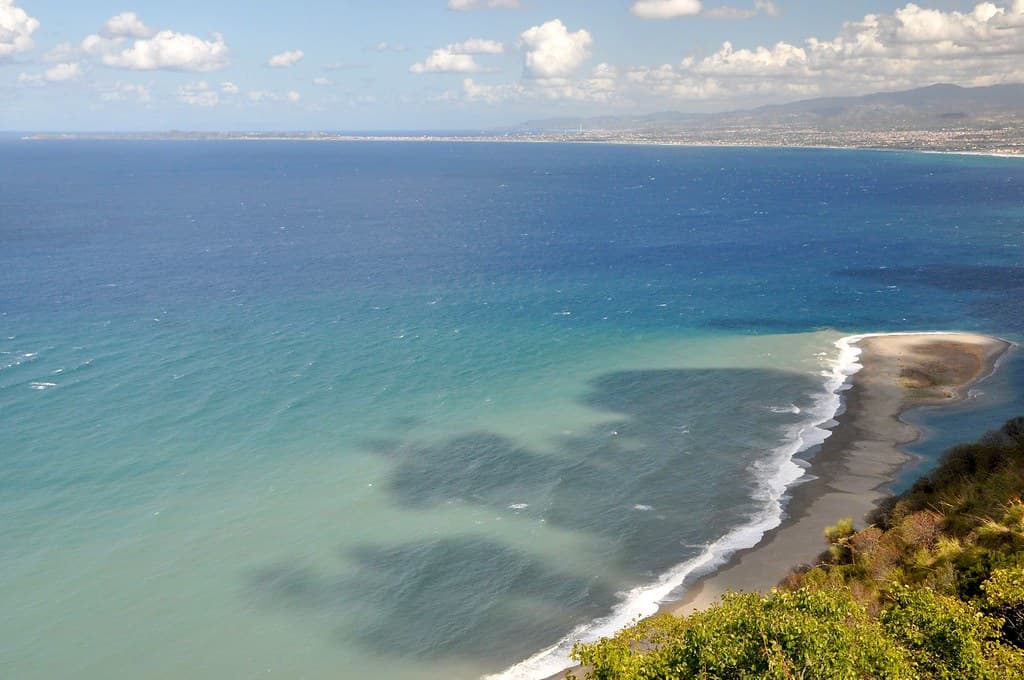
“Below the Sanctuary of Tindari, sand and sea conspire to create a shifting mosaic of tidal pools and ribbons of beach. The lagoons morph with the moon's pull, their outlines redrawn daily, attracting birders,…”
Limited recent visitor reports — live OBI telemetry is your best guide for current conditions.
You hike down a steep, switchbacking trail through macchia and wildflowers, the sanctuary's Byzantine facade receding above while the beach reveals itself in stages—first a sliver of white, then the full crescent backed by the Nebrodi foothills, then the lagoons themselves, shallow basins separated from the Tyrrhenian by sandbars that appear and vanish with the tide.
The water in the pools is ankle-deep and bath-warm, its surface ruffled only by wind and the occasional heron. Families paddle with toddlers while photographers crouch at the waterline, waiting for the light to turn the lagoons silver. The main beach lies just beyond, a broader expanse of fine sand where the waves arrive with more conviction, but most visitors linger in the lagoons, captivated by their impermanence. Local lore holds that the pools once formed the shape of the Madonna's face, a miracle in sand and saltwater, though the contours shift too often now for anyone to agree on what they see.
 Credit: Unsplash
high-angle photography of blue beach
 Credit: Unsplash
brown rock formation on sea during daytime
Switchbacks through macchia and wildflowers
Shifting sandbars, heron visitors
Ankle-deep, bath-warm, tidal basins
Prime Visitation
Best Weather|Less Crowds
Where it is
Laghetti di Marinello Beach
Patti, Sicily, Italy
38.142200°, 15.052900°
Weather
Loading…
Swell
—
Temp
Warm · Restorative
UV Index
Moderate
Wind
—
Tidal State
Last known
Max Sunlight
—
Ideal Shade
—
May - Sep (Peak)
Jan - Dec (Off-season)
Best Weather|Less Crowds
Near Laghetti di Marinello Beach
Explore dining, stays, nightlife, and activities near Laghetti di Marinello Beach in Patti, Italy. Every listing below is a real place linked to this beach — open a card for reviews, maps, and booking options.
Food, cafés, and dining close to Laghetti di Marinello Beach — curated from places linked to this beach.
Stays and lodging options near Laghetti di Marinello Beach for your beach trip.
Activities, tours, and attractions near Laghetti di Marinello Beach.
Select a category to load nearby places.
Unlock restaurants, luxury stays and curated maritime experiences within 2km
Swimming is generally safe at Laghetti di Marinello, but conditions vary. The beach sits within a protected nature reserve where lagoons form and shift seasonally between the sea and shore. Water depth and currents can change, so exercise caution and assess conditions upon arrival. The area is relatively undeveloped with limited lifeguard services, so swimmers should be confident and aware. The lagoons themselves are typically shallow and calm. Families should supervise children closely due to the natural, unmonitored environment and variable water conditions.
Visit during late spring through early fall for the best weather and accessible trails. Summer offers warmest swimming conditions but more visitors. The lagoons' appearance changes seasonally—they're most dramatic after winter rains and can partially dry in peak summer. For photography and fewer crowds, consider May-June or September-October. Avoid visiting after heavy rains when trails may be muddy. The hike down from the Sanctuary of Tindari above can be hot in midday summer sun, so early morning or late afternoon visits are ideal for comfort.
Access requires a moderately challenging hike. From the Sanctuary of Tindari (accessible by car or bus from Patti), follow marked trails down to the beach—about 30-45 minutes descending. The path can be steep and rocky, so wear sturdy shoes. Alternatively, in summer, boat services may operate from nearby Oliveri or Falcone beaches, offering easier access. There's no direct road to the beach itself, preserving its natural character. Plan for the uphill return hike, which takes longer and requires reasonable fitness.
The beach itself has no facilities—it's a protected natural area. Bring water, snacks, and sun protection. The nearby towns of Patti, Oliveri, and Falcone offer restaurants serving Sicilian cuisine and seafood, plus supermarkets for provisions. Accommodation ranges from hotels and B&Bs to agriturismos in the surrounding area. The Sanctuary of Tindari has a café and facilities. For a full beach day, pack everything you need; for dining and lodging, base yourself in one of the neighboring towns just minutes away by car.
Laghetti di Marinello is extraordinary for its ever-changing landscape of saltwater lagoons that form between the beach and sea, creating mirror-like pools against white sand. The beach sits directly below the dramatic clifftop Sanctuary of Tindari, offering stunning views from above and below. This protected nature reserve showcases unique coastal ecology with shifting sandbars and lagoons whose shapes transform seasonally. The turquoise waters and pristine setting make it one of Sicily's most photographed beaches. Its relative inaccessibility preserves an untouched quality rare on popular Mediterranean coasts.
Photos