Counting the waves…
Counting the waves…
A refined fusion of water purity, environmental stability, and communal vibrancy for Ficogrande Beach.
View MethodologyAnalyzed via live sensors and environmental data.
Wave height, wind, and atmospheric stability.
Live footfall and crowd balance metrics.
Community reviews and curated sentiment.
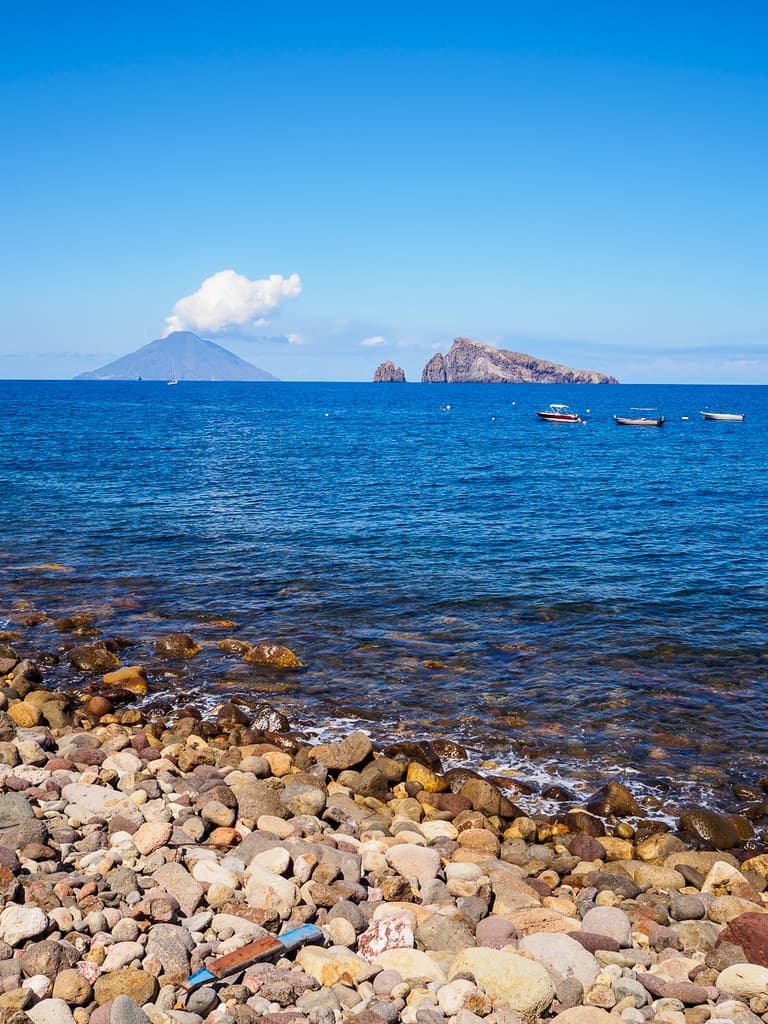
“The stones are warm through your towel, heated by island fire far below. Every twenty minutes the volcano coughs, and you watch smoke rise into impossibly blue sky while wavelets rearrange the dark shore in whispers.”
Limited recent visitor reports — live OBI telemetry is your best guide for current conditions.
You step off the hydrofoil onto an island where the volcano dictates everything—ferry schedules, evacuation routes, the very ground beneath the village of Ficogrande. The beach stretches along the settlement's edge, a ribbon of volcanic rock fragments polished smooth by Tyrrhenian currents. These aren't the black sand grains of postcards but actual pebbles, ranging from chickpea to plum-sized, charcoal and obsidian and basalt clacking together with each retreating wave. Lie on them long enough and the heat transfers through your beach mat—not just sunlight but geothermal warmth rising through layers of cooled lava.
The cone dominates everything, rising twenty-four hundred feet almost directly behind the beach, its slopes terraced with Mediterranean scrub that somehow clings to ash and rock. You'll be reading, swimming, dozing when the grumble comes—a deep-throat clearing from the earth itself—followed by the puff of gray smoke from the summit crater. Locals barely glance up. The rhythm of explosions, roughly three per hour during active periods, becomes your clock, your heartbeat, the bass note under every conversation and every moment of supposed relaxation on this shoreline.
 Credit: Unsplash
high-angle photography of blue beach
 Credit: Unsplash
brown rock formation on sea during daytime
Crater glows red after sunset
Volcanic coastline meets Tyrrhenian Sea
Guided summit treks after dark
Prime Visitation
Anytime
Where it is
Ficogrande Beach
Stromboli, Sicily, Italy
38.792000°, 15.214000°
Weather
Loading…
Swell
—
Temp
Warm · Restorative
UV Index
Moderate
Wind
—
Tidal State
Last known
Max Sunlight
—
Ideal Shade
—
May - Sep (Peak)
Jan - Dec (Off-season)
Historical data suggests peak visibility and stable sea temperatures occur during the prime visitation window.
Select a category to load nearby places.
Unlock restaurants, luxury stays and curated maritime experiences within 2km
Swimming at Ficogrande Beach is generally safe despite Stromboli's active volcanic status. The volcano is constantly monitored, and authorities enforce safety protocols. The beach itself is at a safe distance from the crater. Water conditions are typically calm, though the pebble beach creates a steeper drop-off than sandy beaches. Volcanic monitoring systems provide warnings if activity increases significantly. The main swimming considerations are typical Mediterranean conditions—check for currents and jellyfish. Local authorities would evacuate the island in case of dangerous volcanic activity.
Ficogrande Beach can be visited year-round, though May through October offers the most comfortable swimming conditions. Summer months (June-August) provide warm seas and long daylight hours, ideal for combining beach time with evening volcano viewing. Spring and autumn offer milder temperatures with fewer tourists. The beach is particularly magical at sunset when you can watch the sun set over the sea while the volcano looms behind you. Winter visits are quieter but expect cooler water and potentially rougher seas, though mild days still occur.
Stromboli is accessible by ferry or hydrofoil from Milazzo, Naples, or other Aeolian Islands like Lipari and Vulcano. The journey from Milazzo takes approximately 2-3 hours. Ficogrande Beach is located in the main village area, just a short walk from where boats dock at Scari port. The island has no cars—transportation is by foot, or you can arrange boat taxis for coastal access. Most accommodations are within easy walking distance of the beach. The compact village makes navigation straightforward.
The Ficogrande and San Vincenzo areas adjacent to the beach offer various dining options, from casual beachside cafes to restaurants serving traditional Aeolian cuisine and fresh seafood. Accommodation includes hotels, guesthouses, and vacation rentals, many with sea and volcano views. The village is small, so most lodging is within a 5-10 minute walk of the beach. Facilities are more limited than on larger islands, and advance booking is recommended, especially in summer. Grocery shops are available for self-catering needs.
While Ficogrande Beach offers excellent views of Stromboli volcano's cone, the crater itself isn't directly visible from the beach due to the angle and distance. However, after dark, you can often see the glow from eruptions reflecting off steam clouds, and occasionally witness lava flows on the Sciara del Fuoco slope. The most dramatic views require hiking toward the volcano or taking a boat tour around the island. The beach provides a unique setting where you can relax while experiencing the presence of an active volcano.
Photos