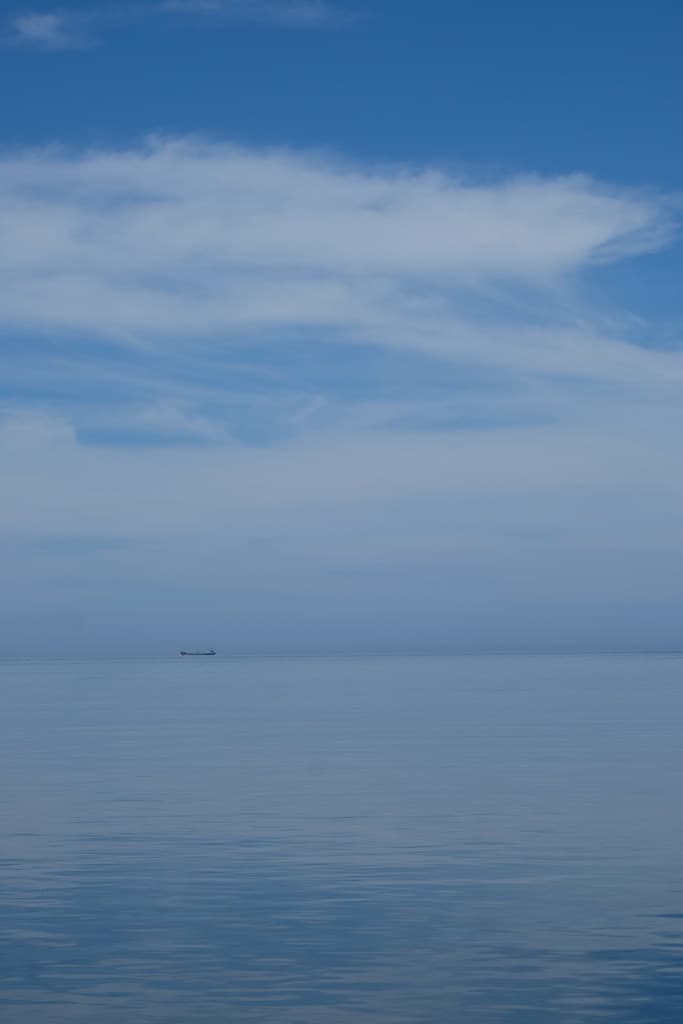
Counting the waves…
Counting the waves…

You reach the end of the line at Wakkanai Port Beach, where Japan's northernmost shore stretches beneath a sky that never quite warms, even in July. The sand here is coarse and gray, shaped by Siberian winds that rake across the Sea of Japan. Cargo ships lumber past breakwaters while gulls wheel overhead, their cries mingling with the clang of harbor machinery. This is not a beach for lounging—it's a frontier, a threshold, a place to turn your collar against the wind and feel the weight of geography. The real drama unfolds at dusk. The sun descends behind Mount Rishiri, the conical volcano rising from an island twenty kilometers offshore, and the entire strait ignites in amber and rust. Locals park along the seawall to watch, thermoses of tea in hand, as the light drains toward Sakhalin. The water here is too cold for swimming most of the year, but summer brave-hearts wade in, gasping at the shock. This beach earns its reputation not through palms or surf but through position. You're standing at the very top of the archipelago, closer to Russia than to Tokyo, where the Soya Strait narrows and the world feels sharply finite. The memorial monuments dot the shoreline—testaments to explorers, fishermen, and a history shaped by isolation and tenacity.
Places, rentals, tours and events within walking and driving distance of Wakkanai Port Beach.
Photos
Wakkanai Port Beach is primarily a scenic waterfront area rather than a traditional swimming beach. The waters can be quite cold year-round due to Wakkanai's northern location, and strong currents from the Sea of Japan make swimming conditions challenging. The beach is better suited for walking, photography, and enjoying coastal views. If you visit during summer months, some locals may wade in shallow areas, but facilities for swimmers are limited. Always check local conditions and signage before entering the water.
While accessible year-round, late spring through early autumn (May-September) offers the most comfortable weather for beach walks and sunset viewing. Summer temperatures range from 15-20°C, making it cooler than southern Japan. Winter brings dramatic seascapes but harsh winds and temperatures well below freezing. Sunset viewing is particularly spectacular during summer months when daylight extends longer. The beach takes on different characters seasonally—lush and accessible in summer, stark and windswept in winter—so your preferred experience will determine timing.
Wakkanai Port Beach is easily accessible from central Wakkanai. It's within walking distance (10-15 minutes) from JR Wakkanai Station, Japan's northernmost railway station. Simply head toward the port area along the waterfront. If driving, street parking and small parking areas are available near the port facilities, though designated beach parking lots may be limited. Wakkanai is reachable by train from Sapporo (approximately 5 hours) or by flight to Wakkanai Airport, followed by a short bus or taxi ride to the waterfront.
Wakkanai city center, adjacent to the beach area, offers various dining options featuring fresh seafood, particularly uni (sea urchin), crab, and local fish. You'll find restaurants serving Hokkaido specialties within walking distance of the waterfront. Accommodation ranges from business hotels to traditional ryokan, mostly concentrated near Wakkanai Station and the port area. The Wakkanai Sun Hotel and ANA Crowne Plaza are popular choices. Convenience stores and small shops are available for quick meals and supplies throughout the city center.
On exceptionally clear days, you can see Sakhalin Island (Russian territory) from Wakkanai Port Beach, located just 43 kilometers across the Soya Strait. This view is not guaranteed and depends heavily on weather conditions—fog and clouds frequently obscure the horizon. Your best chances are during stable, clear weather periods, particularly in summer. The nearby Cape Soya, about 30 minutes from the beach, offers better vantage points for viewing Sakhalin. Wakkanai's position as Japan's northernmost point makes this unique cross-border vista possible when conditions align.