Counting the waves…
Counting the waves…
A refined fusion of water purity, environmental stability, and communal vibrancy for Tsutsuishi North Beach.
View MethodologyAnalyzed via live sensors and environmental data.
Wave height, wind, and atmospheric stability.
Live footfall and crowd balance metrics.
Community reviews and curated sentiment.
“Itoigawa sits on Japan's only jade deposits, and patient beachcombers here discover green nephrite fragments tumbled smooth by the Sea of Japan—some gem-quality, most ordinary, all geologically improbable.”
Limited recent visitor reports — live OBI telemetry is your best guide for current conditions.
The beach stretches in both directions farther than neighboring coves, pebbles extending for nearly a kilometer before rocky headlands terminate the strand. Unlike the cobblestones of Oyashirazu, these stones trend smaller—egg-sized, in colors spanning white quartz, black basalt, rust-stained granite, and occasionally that tell-tale green. Local collectors arrive at dawn after storms, scanning the tide line where heaviest stones accumulate.
The northern position catches wind unfiltered from the Sea of Japan, creating conditions that shift hourly. Morning calm gives way to afternoon chop, waves building as thermal winds accelerate down from the mountains. The fetch here extends to Russia's Primorsky Krai—nothing interrupts the thousand-kilometer sweep across open water. Consequently, the beach collects flotsam from improbable distances: glass fishing floats etched with Cyrillic characters, Korean beverage bottles, sections of Siberian driftwood bleached silver.
 Credit: Unsplash
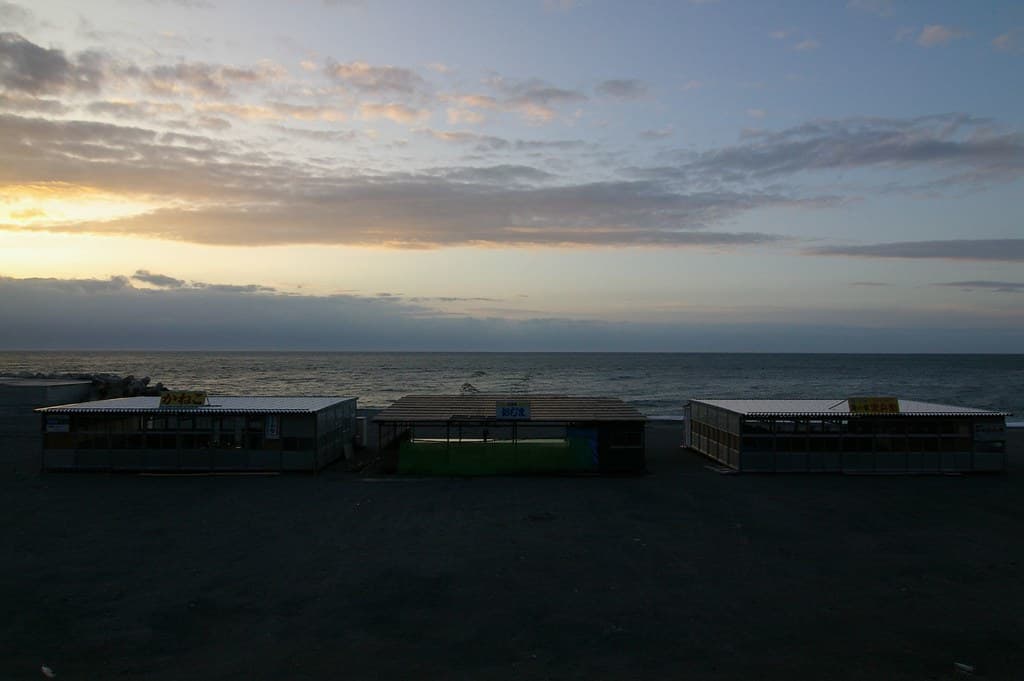
the sun is setting over a body of water
 Credit: Unsplash
a black bird sitting on top of a pile of rocks
Green nephrite among pebbles
Extended pebble shoreline
Long beach walking
Prime Visitation
Less Crowds
Where it is
Tsutsuishi North Beach
Itoigawa, Niigata Prefecture, Japan
37.035000°, 137.805000°
Weather
Loading…
Swell
—
Temp
Warm · Restorative
UV Index
Moderate
Wind
—
Tidal State
Last known
Max Sunlight
—
Ideal Shade
—
May - Sep (Peak)
Jan - Dec (Off-season)
Historical data suggests peak visibility and stable sea temperatures occur during the prime visitation window.
Select a category to load nearby places.
Unlock restaurants, luxury stays and curated maritime experiences within 2km
Swimming conditions at pebble beaches along the Itoigawa coast vary with weather and season. This less-crowded beach likely has limited or no lifeguard services, so swimmers must evaluate conditions independently. Pebble beaches can have steep drop-offs and the Japan Sea can produce strong currents and waves. Wear water shoes to protect feet from stones. Always check weather forecasts before visiting and avoid swimming in rough conditions. The beach's quiet nature means fewer people around if assistance is needed.
Tsutsuishi North Beach is already less crowded than major tourist beaches, making most times suitable for peaceful visits. Weekdays from late spring through early autumn offer the best combination of pleasant weather and solitude. Early mornings and late afternoons are particularly quiet even during summer. The shoulder seasons of May-June and September-October provide comfortable temperatures with minimal visitors. Even peak summer weekends tend to be quieter at hidden beaches like this compared to famous resort areas along Japan's Pacific coast.
Access to Tsutsuishi North Beach is most practical by car, as the western Niigata coast has limited public transportation to smaller beaches. From Itoigawa Station or nearby areas, navigate toward the Tsutsuishi coastal region. Look for local roads leading to the shore, though signage may be minimal in Japanese. The beach's less-crowded status suggests it's not a major developed site, so expect basic or informal access points. Parking may be informal roadside areas rather than official lots. Local maps or GPS navigation are helpful.
As a less-developed beach, Tsutsuishi North Beach has minimal on-site facilities. Bring your own food, drinks, and beach supplies. The nearest restaurants and accommodations are likely in Itoigawa city center, approximately 15-30 minutes away depending on exact location. Itoigawa offers various lodging from business hotels to traditional Japanese inns, plus restaurants featuring local seafood and Niigata rice-based dishes. Roadside stations along coastal routes sometimes offer regional foods and products worth exploring before or after your beach visit.
Tsutsuishi North Beach's pebble composition creates a distinct coastal experience different from sandy beaches. Pebble beaches produce soothing sounds as waves roll stones, and the clear water typical of rocky shores is often excellent for viewing. The less-crowded atmosphere allows for genuine relaxation and connection with nature. The beach's location on the western Niigata coast provides views of the Japan Sea and surrounding mountains. Its relative anonymity means you can enjoy authentic local coastal scenery without tourist development or commercialization.
Photos