Counting the waves…
Counting the waves…
A refined fusion of water purity, environmental stability, and communal vibrancy for Little Hellfire Beach.
View MethodologyAnalyzed via live sensors and environmental data.
Wave height, wind, and atmospheric stability.
Live footfall and crowd balance metrics.
Community reviews and curated sentiment.
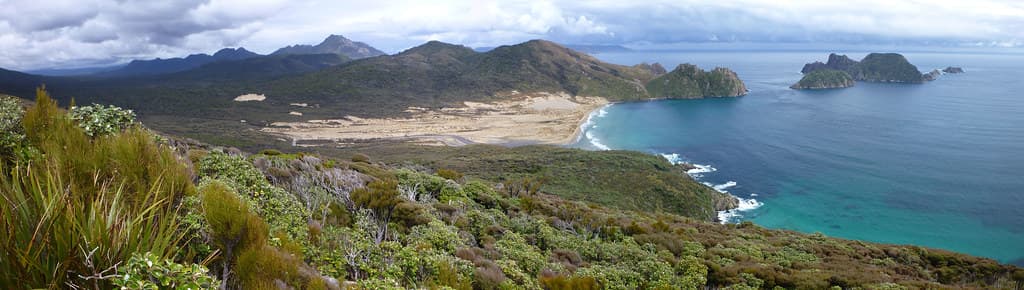
“Little Hellfire Beach hides between forested bluffs, a brief respite of open sand along a coastline otherwise choked with scrub and stone. The name suggests drama; the reality is quieter—just wind, waves, and the steady…”
Limited recent visitor reports — live OBI telemetry is your best guide for current conditions.
You reach Little Hellfire via the Northwest Circuit, descending from muddy forest into the sudden brightness of a beach that's more gravel than sand in places. The shore curves gently, bordered by low dunes fringed with marram grass and the occasional stunted flax. The Tasman rolls in with a businesslike rhythm, neither gentle nor violent, just relentlessly present.
The name—Little Hellfire—comes from early sealers or whalers, though no one remembers exactly why. There's no sulfur, no volcanic vents, just the ordinary wildness of a beach that sees more weather than people. At low tide, rock shelves emerge, slick with Neptune's necklace and dotted with limpets that clamp down as you approach. Oystercatchers patrol the foam line, piping protests when you intrude on their hunting grounds.
Crashing wave at sunset on the shoreline
Northwest Circuit waypoint beach
Limpets and seaweed exposed
Driftwood and marram dunes
Prime Visitation
Best Weather|Less Crowds
Where it is
Little Hellfire Beach
Stewart Island / Rakiura, Southland, New Zealand
-46.792000°, 167.827600°
Weather
Loading…
Swell
—
Temp
Warm · Restorative
UV Index
Moderate
Wind
—
Tidal State
Last known
Max Sunlight
—
Ideal Shade
—
Jan - Dec (Peak)
Mar - Nov (Off-season)
Best Weather|Less Crowds
Select a category to load nearby places.
Unlock restaurants, luxury stays and curated maritime experiences within 2km
Swimming at Little Hellfire Beach is not advisable. The beach faces exposed northwest conditions with strong surf, cold Southern Ocean water temperatures, and dangerous rips and currents. The extreme remoteness means emergency services are days away, and there are no lifeguards or rescue facilities. The beach is best appreciated for its wild scenic value rather than water activities. Even experienced swimmers should avoid entering the water due to unpredictable conditions.
Summer months (December-February) offer the most favorable weather and longest daylight for the multi-day tramp required to reach Little Hellfire Beach. However, Stewart Island weather remains changeable year-round, so prepare for all conditions. These months also provide slightly warmer temperatures and better track conditions. Visitor numbers are always minimal due to the remote location. Avoid winter unless you're highly experienced in extreme backcountry conditions.
Little Hellfire Beach is reached via the Northwest Circuit, one of New Zealand's most challenging Great Walks, requiring 9-11 days to complete. Start from Oban on Stewart Island, accessible by ferry from Bluff or flight from Invercargill. The track demands excellent fitness, navigation skills, and full self-sufficiency with camping and food supplies. You'll need to book DOC huts in advance. This is serious backcountry tramping suitable only for experienced, well-prepared hikers.
No facilities exist at Little Hellfire Beach. Trampers must carry all provisions from Oban, the only settlement on Stewart Island with shops, restaurants, and accommodation. DOC huts along the Northwest Circuit provide basic shelter but you must bring your own food and cooking equipment. The nearest hut varies depending on your route and may be several hours' walk away. Complete self-sufficiency is essential for this wilderness experience.
Little Hellfire Beach showcases Stewart Island's raw northwest coastline with powerful surf, dramatic rock formations, and exceptional wilderness character. The beach rewards trampers who complete the challenging Northwest Circuit with pristine isolation and spectacular coastal scenery. Birdlife is abundant, and the rugged beauty represents New Zealand's wilderness at its most untamed. The name itself hints at the dramatic, almost otherworldly landscape. Few travelers ever reach this remote shore, making it a true wilderness achievement.
Photos