Counting the waves…
Counting the waves…
A refined fusion of water purity, environmental stability, and communal vibrancy for Maya Bay.
View MethodologyAnalyzed via live sensors and environmental data.
Wave height, wind, and atmospheric stability.
Live footfall and crowd balance metrics.
Community reviews and curated sentiment.
“Your boat idles outside the channel while the park ranger checks tickets and counts heads. Inside, the bay curves like a amphitheater, cliffs rising vertical from sand that's been closed to swimmers since 2018 to let…”
Limited recent visitor reports — live OBI telemetry is your best guide for current conditions.
You step off the boat onto the channel's shallow reef flat—not the beach itself, which remains roped off behind signs in Thai and English. The restoration is working: juvenile blacktip reef sharks patrol the shallows where Leonardo DiCaprio once ran, and staghorn coral fragments have sprouted into dinner-plate colonies. The water temperature hovers at 29 degrees Celsius, warm enough that you'll snorkel without thermal protection.
The bay's horseshoe shape creates unusual acoustics. Waves slapping the outer reef echo off the limestone, arriving at your ears half a second delayed, like a natural reverb chamber. Above, the cliffs lean inward, their upper reaches draped in pandanus and strangler figs whose roots dangle like cables. Longtail boats raft up in the middle of the bay, twenty at a time during peak hours, their drivers smoking cigarettes and waiting for the thirty-minute visit window to expire.
 Credit: Unsplash
a group of boats sitting on top of a sandy beach
 Credit: Unsplash
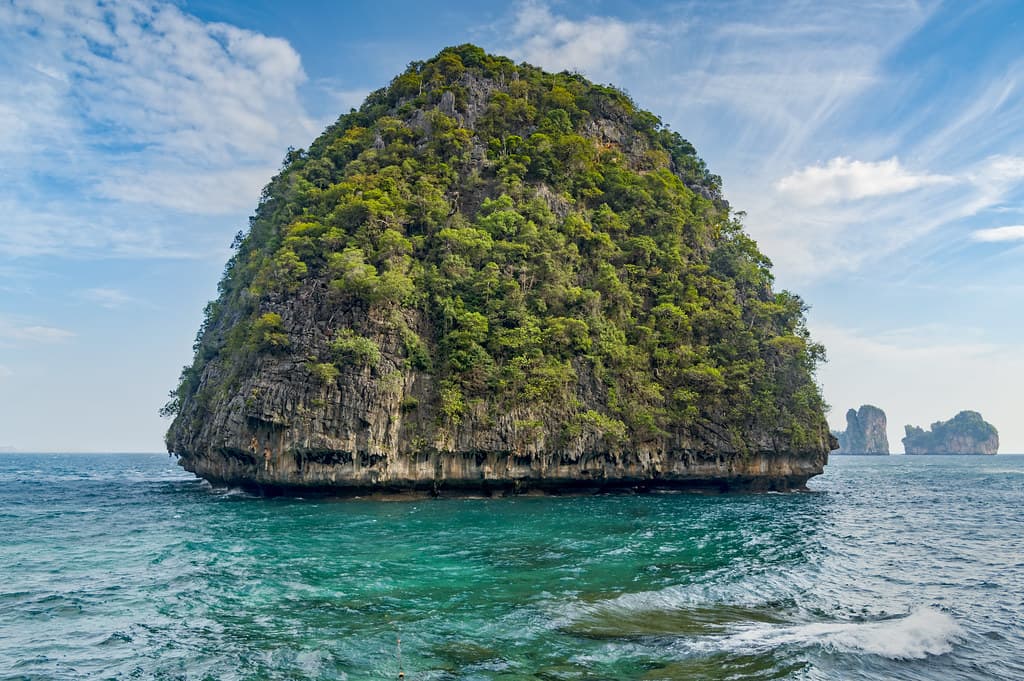
a small island in the middle of the ocean
Juvenile corals and blacktips
Recreate that iconic shot
Eastern cut pulls strong
Prime Visitation
Best Weather
Where it is
Maya Bay
Phi Phi Don, Krabi, Thailand
7.670100°, 98.767800°
Weather
Loading…
Swell
—
Temp
Warm · Restorative
UV Index
Moderate
Wind
—
Tidal State
Last known
Max Sunlight
—
Ideal Shade
—
Jan - Dec (Peak)
May - Nov (Off-season)
Historical data suggests peak visibility and stable sea temperatures occur during the prime visitation window.
Near Maya Bay
Explore dining, stays, nightlife, and activities near Maya Bay in Phi Phi Don, Thailand. Every listing below is a real place linked to this beach — open a card for reviews, maps, and booking options.
Activities, tours, and attractions near Maya Bay.
Select a category to load nearby places.
Unlock restaurants, luxury stays and curated maritime experiences within 2km
Maya Bay's access status has changed over recent years due to environmental restoration efforts. The bay was closed from 2018 to early 2022 to allow ecosystem recovery from overtourism. It has since reopened with strict regulations: limited daily visitors, no swimming allowed, no boats entering the bay (visitors land at Loh Samah Bay and walk over), and time limits. These rules protect the recovering coral and marine life. While you cannot swim, you can walk on the beach for photos. Always check current regulations before visiting, as rules may evolve based on conservation needs.
The best time to visit Maya Bay is during the dry season from November to April, when weather is optimal with calm seas, clear skies, and minimal rainfall. This period offers the most reliable boat access and comfortable touring conditions. However, visitor numbers are now strictly controlled regardless of season to protect the environment. The bay may close during monsoon season (May-October) due to rough seas and park management schedules. Arriving on the earliest possible tour (before 9am) helps you experience the bay with fewer people and better lighting for photography of this iconic location.
Maya Bay is located on Phi Phi Leh island and accessible only by organized tours, as independent access is restricted. From Phuket, Krabi, or Ao Nang, book a day tour (speedboat or longtail boat) that includes Maya Bay, typically combined with other Phi Phi islands stops. Tours take 45 minutes to 2 hours depending on departure point and vessel type. Alternatively, stay on Phi Phi Don island and join a shorter tour from there. All visitors must pay national park fees, and tour operators must have proper permits. Advanced booking is recommended due to daily visitor limits.
Maya Bay has absolutely no accommodation, restaurants, or commercial facilities. Phi Phi Leh island is uninhabited and protected as part of Hat Noppharat Thara-Mu Ko Phi Phi National Park, with strict conservation regulations. Visits are limited to brief stops (typically 30-60 minutes) as part of day tours. All lodging and dining options are on neighboring Phi Phi Don island, particularly around Tonsai Village, which offers everything from budget hostels to boutique resorts and numerous restaurants. Alternatively, stay in Phuket, Krabi, or Ao Nang and visit Maya Bay on day trips. Bring water and snacks for your tour.
Maya Bay achieved worldwide fame as the stunning filming location for the 2000 movie "The Beach" starring Leonardo DiCaprio. Its dramatic limestone cliffs encircling a white sand beach with crystal-clear turquoise waters created an iconic image of tropical paradise. However, visitor expectations should be adjusted: the bay now has strict regulations to protect its ecosystem after years of damage from overtourism. You cannot swim, boats don't enter the bay, visit times are limited, and daily visitor numbers are capped. Despite restrictions, the scenery remains breathtaking and worth experiencing, especially given the conservation success story it represents.
Photos