Counting the waves…
Counting the waves…

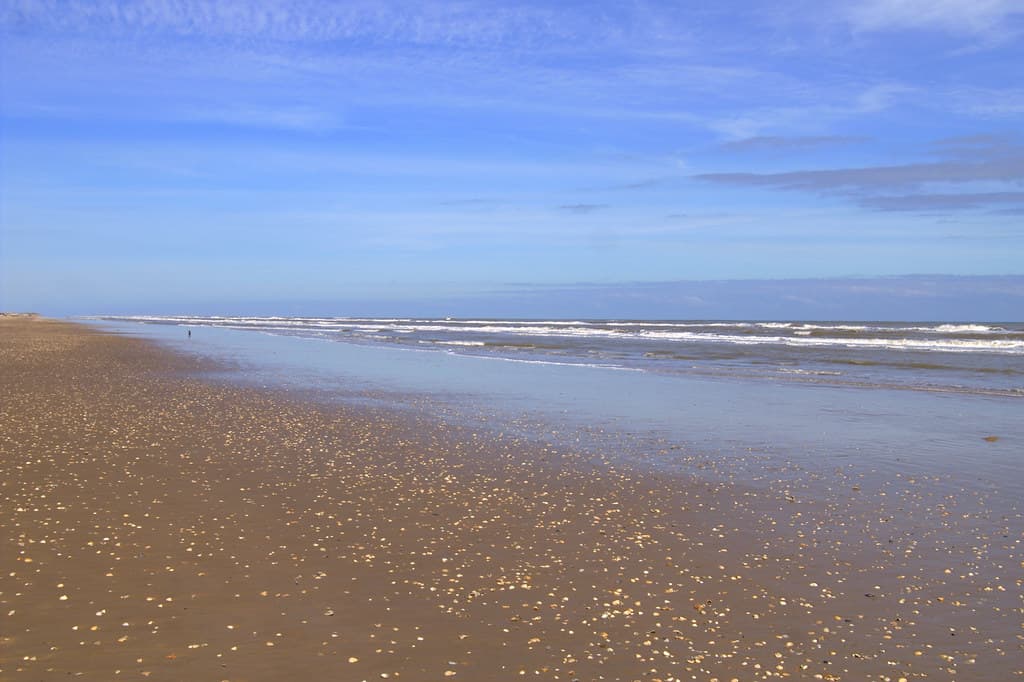
Park Avenue dead-ends into a soft-sand parking area where four-wheel-drive tracks disappear into low dunes stippled with sea oats. Beyond the first rise, the beach unfolds in both directions—no umbrellas, no volleyball nets, just the rhythmic crash of green-gray Gulf water and the occasional ghost crab scuttling toward its burrow. The sand here holds tire treads and shorebird prints in equal measure, and the only shade comes from the dunes themselves, their windward faces carved smooth by the prevailing southeast breeze. Mid-afternoon light turns the water murky jade, but as the sun drops toward the Laguna Madre behind you, the wet sand at the tideline takes on a bronze sheen. Sandwich terns dive-bomb the surf. A few trucks are scattered along the beach, their occupants casting lines into the first gut or simply sitting tailgate-down with coolers and folding chairs. The isolation feels earned rather than manufactured—this isn't a secret beach so much as a patient one, rewarding those who drive past the last hotel. By twilight, the western sky behind the island flares pink and tangerine, reflected in the shallow tidal pools dotting the foreshore. You'll leave with sand in every crevice and salt on your skin, the kind of honest beach grime that reminds you what the Gulf was like before anyone thought to pave it.
Places, rentals, tours and events within walking and driving distance of North End Dune Beach.
Photos
Swimming conditions at North End Dune Beach vary throughout the year. The Gulf waters here can have stronger currents and less lifeguard presence compared to central South Padre Island beaches. Check local beach flag warnings before entering the water—red flags indicate dangerous conditions. The beach is more remote, so swim with caution and never alone. Spring and summer generally offer calmer waters, while fall and winter may bring rougher surf. Always supervise children closely and be aware of rip currents, which can occur along the Texas coast.
North End Dune Beach is accessible year-round, with each season offering different experiences. Spring (March-May) and fall (September-November) provide comfortable temperatures in the 70s-80s°F with fewer crowds than summer. Summer (June-August) brings hot, humid weather perfect for swimming but more visitors. Winter (December-February) offers mild temperatures around 60-70°F, ideal for beachcombing and birdwatching, though water is cooler. The beach's remote location means it's generally quieter than central island beaches regardless of season. Sunset viewing is spectacular throughout the year.
North End Dune Beach is located at the far northern tip of South Padre Island, accessible via Park Road 100. From central South Padre Island, drive north on Padre Boulevard, which becomes Park Road 100. The road is paved for several miles before transitioning to sand. Four-wheel-drive vehicles are recommended for the final stretch, though not always required depending on conditions. Beach driving permits may be needed for certain areas. Parking is available along the beach access points, but facilities are minimal in this undeveloped area.
North End Dune Beach is in an undeveloped area with no immediate restaurants, hotels, or amenities. The nearest services are in central South Padre Island, approximately 5-10 miles south, where you'll find numerous hotels, vacation rentals, restaurants, and convenience stores. Plan to bring your own food, water, and supplies for a beach day. There are no restrooms or showers at the north end. Some visitors stay in central South Padre Island and make a day trip to enjoy the quieter, more natural setting of the north end beaches.
North End Dune Beach offers a more remote, natural experience compared to the developed southern portions of South Padre Island. The area features pristine dunes, minimal development, and significantly fewer crowds. It's particularly popular for nature photography, birdwatching, and sunset viewing. The beach appeals to visitors seeking solitude and a more wilderness feel. Beach driving is common here, and the undeveloped landscape provides habitat for coastal wildlife. The trade-off for this natural setting is the lack of amenities, lifeguards, and facilities found at more developed island beaches.