
The beach earns its name not from gemstones but from garnet-flecked sand that glints burgundy when wet, a consequence of the Olympic Mountains' metamorphic bedrock grinding into the sea. You navigate a maze of driftwood logs—some as thick as your torso, stripped gray by relentless surf—while Harbor seals surface beyond the kelp line, their whiskers twitching as they track salmon runs.
“The garnet-rich sand shifts from gray to wine-dark depending on saturation and light angle, visible nowhere else on the Olympic coast.”
 Credit: Flickr
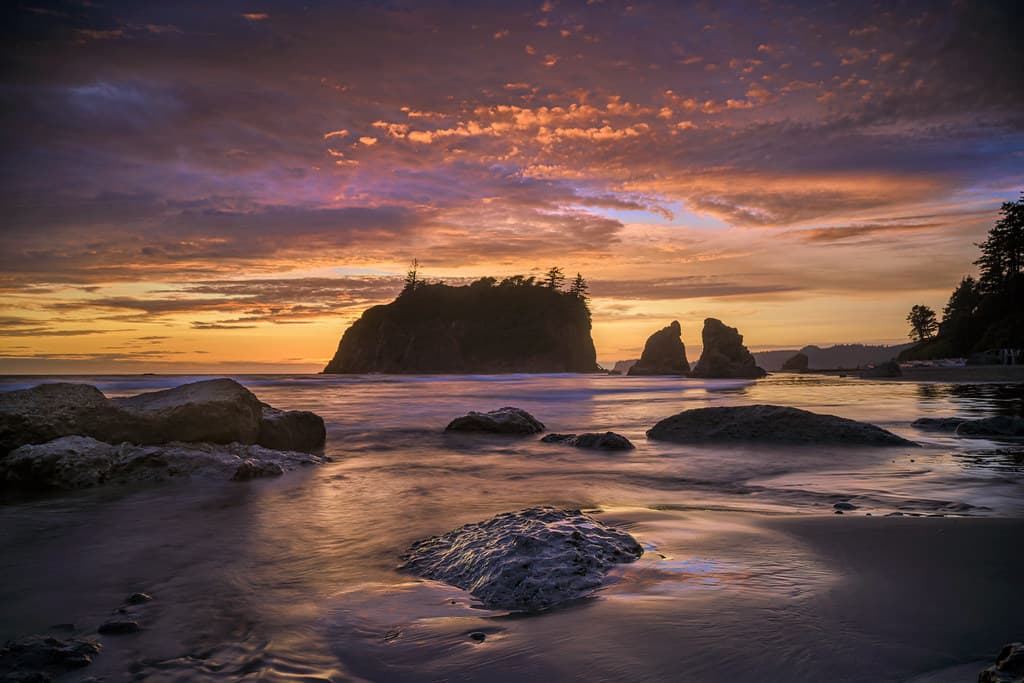
Sunset over sea stacks at Ruby Beach, Olympic National Park, Olympic Peninsula, Washington State
Abbey Island dominates the southern view, its forested crown severed from the mainland by centuries of wave action. At minus tides, you can walk tidepool channels where ochre stars cling to basalt and hermit crabs scuttle through forests of rockweed. The water never exceeds fifty-five degrees, even in August, and sneaker waves claim the unwary—you'll want to watch the surf rhythm before turning your back.
Winter storms reshape the beach overnight, piling driftwood into new configurations and exposing agates in the cobble berms. Morning fog condenses on Sitka spruce needles in the forest behind you, dripping steadily onto sword ferns. You'll leave with sand the color of dried blood under your fingernails and the bass note of breakers lodged in your chest.


