Counting the waves…
Counting the waves…
A refined fusion of water purity, environmental stability, and communal vibrancy for Possession Bay Beach.
View MethodologyAnalyzed via live sensors and environmental data.
Wave height, wind, and atmospheric stability.
Live footfall and crowd balance metrics.
Community reviews and curated sentiment.
“You'll crunch across wave-polished stones beneath glaciated peaks where James Cook first claimed South Georgia for the Crown. Elephant seals grunt from the tide line, fur seals patrol the wrack, and the wind carries the…”
Limited recent visitor reports — live OBI telemetry is your best guide for current conditions.
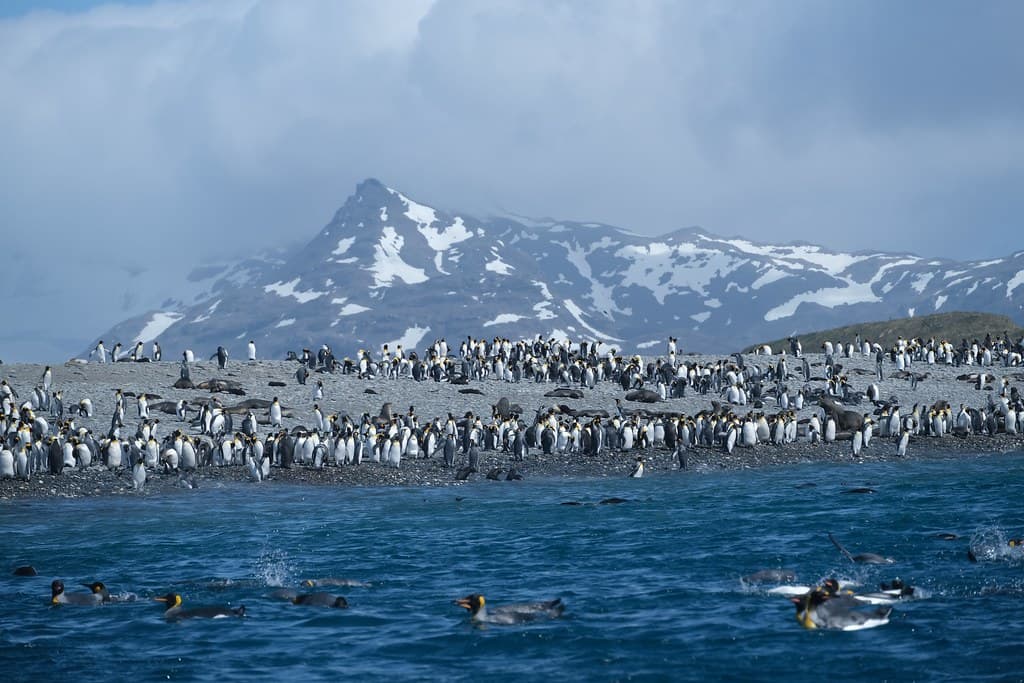
The pebbles shift beneath your boots—gray, black, rust-streaked ovals smoothed by centuries of Southern Ocean surge. Possession Bay curves along South Georgia's northern coast in a broad crescent, its beach a congregation point for Antarctic fur seals that bark and joust at the water's edge, seemingly indifferent to the historic weight of this shore. On January 17, 1775, Captain Cook raised the Union Jack somewhere near here, claiming an island he mistakenly thought might be the fabled southern continent. The mountains behind you—ice-draped, raw-edged—rise as they did then, indifferent witnesses to empire.
You're more likely to share this strand with molting elephant seals than other travelers. Expedition cruise Zodiacs land when swell and wind allow, depositing you into a tableau of tussock grass, kelp windows, and the distant white silence of hanging glaciers. The air tastes of krill and stone; the cold presses through every layer. Skuas patrol overhead, and if you're quiet near the stream mouth, you might spot South Georgia pipits—the world's most southerly songbird—hunting midges among the cobbles.
 Credit: Unsplash
a sandy beach with a body of water in the background
 Credit: Unsplash
sea waves crashing on shore during daytime
Keep five meters minimum distance
Follow marked heritage route inland
Morning light reveals ice detail
Prime Visitation
Best Weather | Less Crowds
Where it is
Possession Bay Beach
Possession Bay, Antártida e Islas del Atlántico Sur, Argentina
-54.112700°, -37.124600°
Weather
Loading…
Swell
—
Temp
Warm · Restorative
UV Index
Moderate
Wind
—
Tidal State
Last known
Max Sunlight
—
Ideal Shade
—
Jan - Dec (Peak)
Mar - Nov (Off-season)
Best Weather | Less Crowds
Select a category to load nearby places.
Unlock restaurants, luxury stays and curated maritime experiences within 2km
Swimming is extremely dangerous and not recommended at Possession Bay Beach due to near-freezing water temperatures that can cause hypothermia within minutes. Strong currents, unpredictable winds, and the presence of large marine mammals like elephant seals make water entry hazardous. The beach is primarily a wildlife viewing and historical landing site rather than a recreational destination. Visitors should maintain required distances from all wildlife, particularly during breeding season when animals can be aggressive. Always follow your expedition guide's safety protocols and never enter the water without professional supervision and proper equipment.
The optimal visiting window is November through March during the sub-Antarctic summer, with December to February offering peak wildlife activity and relatively mild weather. November sees the arrival of breeding seals and birds, while January and February feature penguin chicks and seal pups. March provides fewer expedition vessels and unique autumn conditions, though some wildlife may have departed. Weather remains notoriously changeable on South Georgia year-round. All visits depend on sea conditions allowing safe Zodiac landings, which expedition leaders assess daily regardless of planned itineraries.
Access requires booking an expedition cruise to South Georgia, typically departing from Ushuaia, Argentina, or the Falkland Islands. The voyage takes approximately two days across the Southern Ocean. Possession Bay Beach is reached by Zodiac inflatable boat from your cruise ship, weather and sea conditions permitting. No airports, regular ferry services, or independent travel options exist for South Georgia. All landings require permits from the Government of South Georgia and the South Sandwich Islands. Your expedition operator handles necessary permissions, but landings are never guaranteed due to weather variability.
No commercial accommodations, restaurants, or tourist facilities exist at Possession Bay or anywhere on South Georgia Island. All visitors stay aboard their expedition cruise ships, which provide all meals, lodging, and amenities. Shore visits are typically brief, lasting two to four hours depending on conditions and itinerary. No shops, cafes, or services are available on the island. The nearest permanent settlement is the British Antarctic Survey station at King Edward Point, which is not open to tourists. Visitors must be completely self-sufficient, with ships providing everything needed.
Possession Bay holds exceptional historical importance as the location where Captain James Cook first landed on South Georgia in January 1775, claiming the island for Great Britain. The bay's name commemorates this formal act of possession. The beach area later became significant during the whaling era and features in Sir Ernest Shackleton's legendary 1916 crossing of South Georgia. Shackleton's party passed near Possession Bay during their desperate trek to reach the whaling station at Stromness. Today, visitors can reflect on this remarkable exploration history while observing the wildlife that has always characterized this remote coast.
Photos