
Playa Punta Baja earns its name from topography rather than drama—this is a gentle protrusion rather than a dramatic cliff, a place where the beach bulges seaward just enough to create different conditions on either flank. The northern side accumulates fine pebbles and shells, sorted by size through wave action. The southern side is all cobbles and boulders, some large enough to sit on while you rest legs exhausted from unstable footing.
“This subtle headland creates distinct microclimates on each side, concentrating diverse seabird populations in a compact area.”
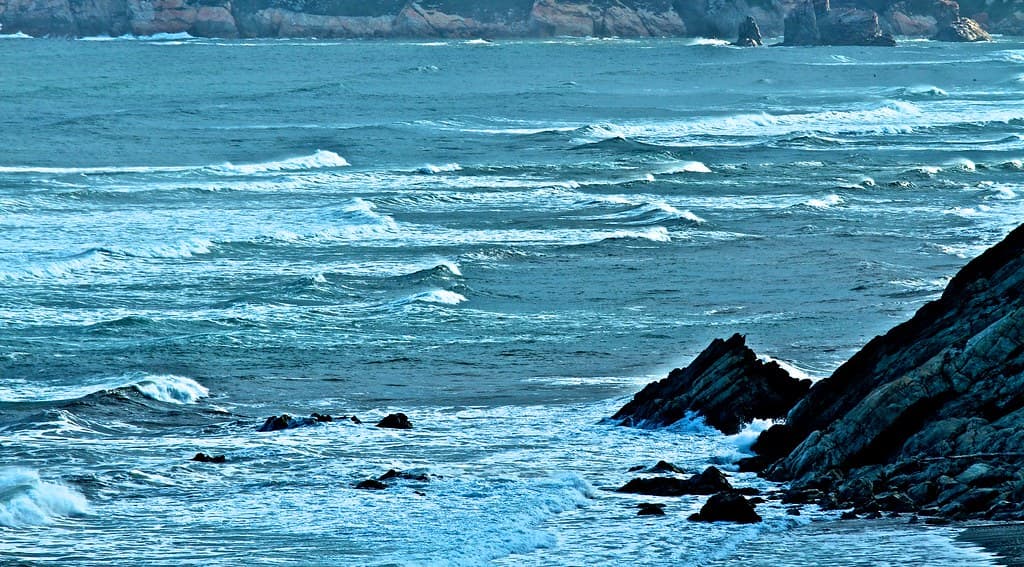 Credit: Flickr
La piel del mar :: The Skin of the Sea :: 20140815 8501
Shorebirds treat this point as a staging area. You watch two-banded plovers sprint along the waterline, their legs a blur as they chase receding foam. Farther out, kelp geese bob in the swells, diving for the algae that gives them their name. The diversity here exceeds what you'll find at more famous Patagonian sites, precisely because human traffic is minimal. You settle onto a flat boulder and glass the offshore zone with binoculars, counting species: imperial cormorants, rock shags, dolphin gulls, the occasional giant petrel gliding past on two-meter wings.
The point creates a slight wind shadow on its western side during prevailing conditions, offering marginal relief. You take advantage of this to brew tea on a camp stove, anchoring your cookpot between rocks. The water boils slowly at this southern latitude's insistent wind. When you finally sip the mate cocido, the warmth spreads through your chest like a small rebellion against the elements. To the south, Cabo Vírgenes lighthouse marks the horizon. To the north, nothing but empty coast extending toward Rio Gallegos.


