Counting the waves…
Counting the waves…
A refined fusion of water purity, environmental stability, and communal vibrancy for Tidal River Beach.
View MethodologyAnalyzed via live sensors and environmental data.
Wave height, wind, and atmospheric stability.
Live footfall and crowd balance metrics.
Community reviews and curated sentiment.
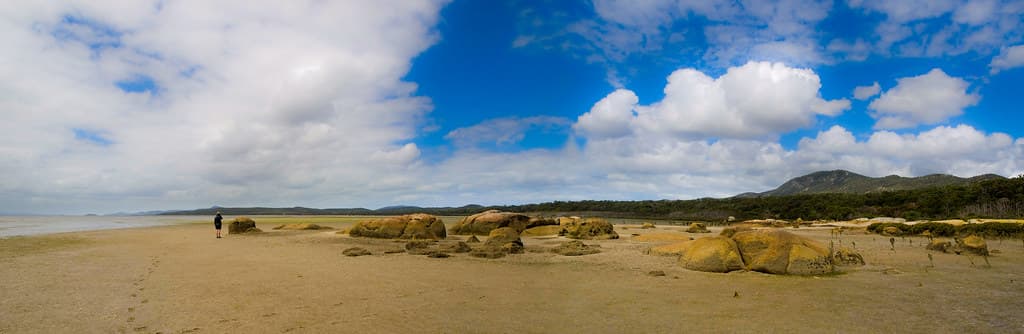
“Tidal River Beach curves between Wilsons Promontory's eucalypt-clad hills and the Bass Strait, its shallow amber shallows warming under the sun while eastern grey kangaroos graze the dunes behind you. The beach unfurls…”
Limited recent visitor reports — live OBI telemetry is your best guide for current conditions.
You'll smell the tea-tree and banksia before you see the ocean—Tidal River sits in a natural amphitheater where Wilsons Promontory's forested ridges meet a sandy shore that changes character with the tide. At low water, the beach stretches wide and firm, revealing tide pools stippled with periwinkles and small crabs. Children crouch with buckets while parents set up shade tents near the dune grass, and the shallow gradient means you can wade fifty meters out before the water reaches your waist.
The campground spills almost onto the sand, close enough that you hear the surf from your tent at night. Mornings bring a parade of wildlife: wombats trundling back to their burrows after nocturnal foraging, crimson rosellas flashing through the she-oaks, and the occasional echidna shuffling along the beach access tracks. The Prom, as locals call it, is Victoria's southernmost point, and Tidal River serves as the park's social heart—a place where multi-generational families return year after year, claiming the same sites.
 Credit: Unsplash
green trees on brown sand near body of water during daytime
 Credit: Unsplash
A reflective lake with sandy shore and forested mountains
Warm pools at low tide
Two-hour return granite scramble
Dusk near campground loop roads
Where it is
Tidal River Beach
Tidal River, Victoria, Australia
-39.009800°, 146.453200°
Weather
Loading…
Swell
—
Temp
Warm · Restorative
UV Index
Moderate
Wind
—
Tidal State
Last known
Max Sunlight
—
Ideal Shade
—
Jan - Dec (Peak)
Mar - Nov (Off-season)
Historical data suggests peak visibility and stable sea temperatures occur during the prime visitation window.
Select a category to load nearby places.
Unlock restaurants, luxury stays and curated maritime experiences within 2km
Swimming conditions at Tidal River Beach are generally calm and family-friendly, as the beach is sheltered within Wilson's Promontory National Park. The waters are typically gentle, making it suitable for children and less confident swimmers. However, always check local conditions before entering the water, as currents can vary. There are no patrolled beaches or lifeguards on duty, so swim at your own risk and stay within your depth. During summer, the water temperature is comfortable, though it remains cool year-round typical of southern Australian waters.
Tidal River Beach is accessible year-round, though each season offers different experiences. Summer (December-February) is most popular for swimming and camping, with warmer temperatures and longer days, but requires advance bookings. Autumn and spring offer milder weather, fewer crowds, and excellent wildlife viewing opportunities. Winter can be cold and wet but provides dramatic coastal scenery and solitude. Regardless of season, weather at Wilson's Promontory can change quickly, so pack layers and rain gear. School holidays and long weekends see peak visitation.
Tidal River Beach is located within Wilson's Promontory National Park, approximately 3 hours' drive southeast of Melbourne via the South Gippsland Highway. From the park entrance, it's another 30-kilometre drive to Tidal River. There's no public transportation, so a private vehicle is necessary. Parking is available at Tidal River near the beach and campground areas. During peak periods, parking can fill quickly. Park entry fees apply, and camping permits are required if staying overnight. The final access road is sealed and suitable for all vehicles.
Tidal River offers a well-equipped campground with powered and unpowered sites, plus wilderness cabins and safari tents (bookings essential, especially in summer). A general store sells basic groceries, camping supplies, hot food, and coffee, though options are limited and prices higher than urban areas. There are no restaurants, so most visitors bring their own food or use campground BBQ facilities. The nearest towns with supermarkets and fuel are Foster and Fish Creek, about an hour's drive away. Book all accommodation well in advance through Parks Victoria.
Tidal River is renowned for close wildlife encounters, particularly with eastern grey kangaroos and wombats that frequently graze around the campground and beach areas, especially at dawn and dusk. The area is also home to emus, echidnas, and various bird species. Don't feed the animals despite their approachability—it's illegal and harmful to them. In coastal waters and from nearby lookouts, you may spot dolphins, seals, and during migration seasons (May-October), southern right whales. Always maintain a respectful distance and never approach or touch wildlife.
Photos