
The Eyre Highway skirts the continent's southern edge here, and when you pull off onto the rough track leading to the cliffs, you enter a landscape stripped to its essentials. Rust-red earth gives way abruptly to pale limestone, fractured and sheared by millennia of Southern Ocean storms. The cliffs run in both directions as far as you can see—a geological drama playing out across 200 kilometers of coastline. Below, waves surge into blowholes and sea caves, their roar carried up on wind that never stops.
“The world's longest uninterrupted sea cliff formation offers true terrestrial isolation along one of Earth's straightest coastlines.”
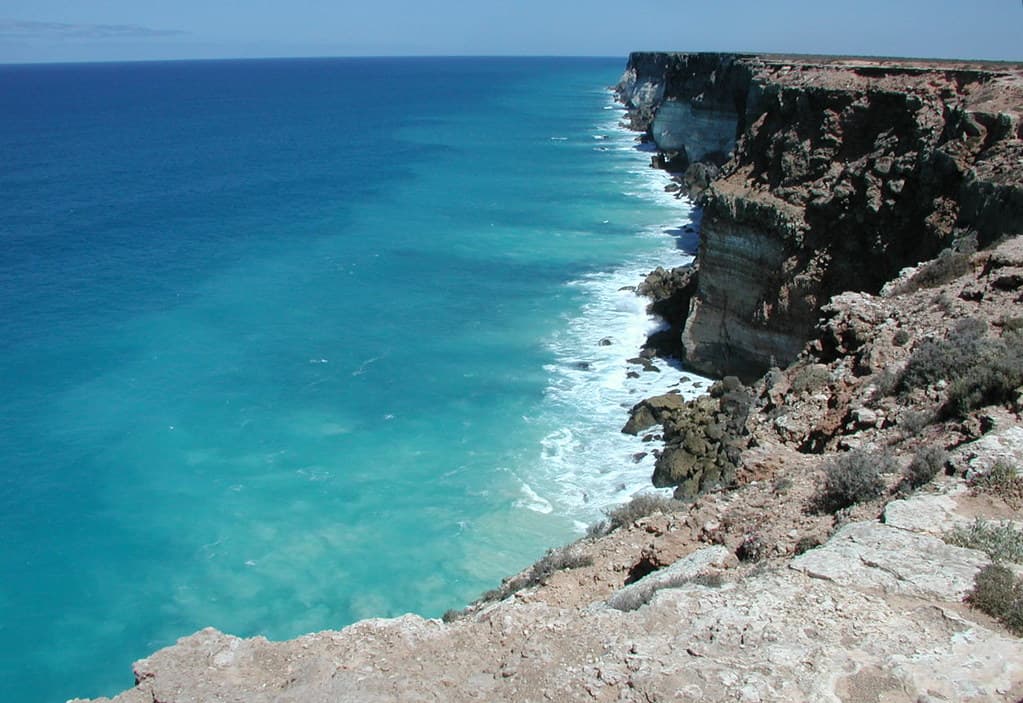 Credit: Flickr
view West along the Bunda Cliffs
This isn't a beach for swimming or sunbathing. You're here to witness scale: the vast indifference of ocean meeting continent, the way afternoon light turns the water from steel-blue to pewter, the absolute silence once you kill your engine. Whales breach offshore during their annual migration. Wedge-tailed eagles ride thermals along the cliff edge. The sparse vegetation—saltbush, bluebush, samphire—clings low to the ground.
Bring everything you need: water, fuel, food. The nearest substantial town is hours away in either direction. Your mobile phone is a paperweight. But that's precisely the point. You've come to the edge of the world, where the only company is the wind and the steady percussion of waves against stone, and for a few hours or days, nothing else exists.


