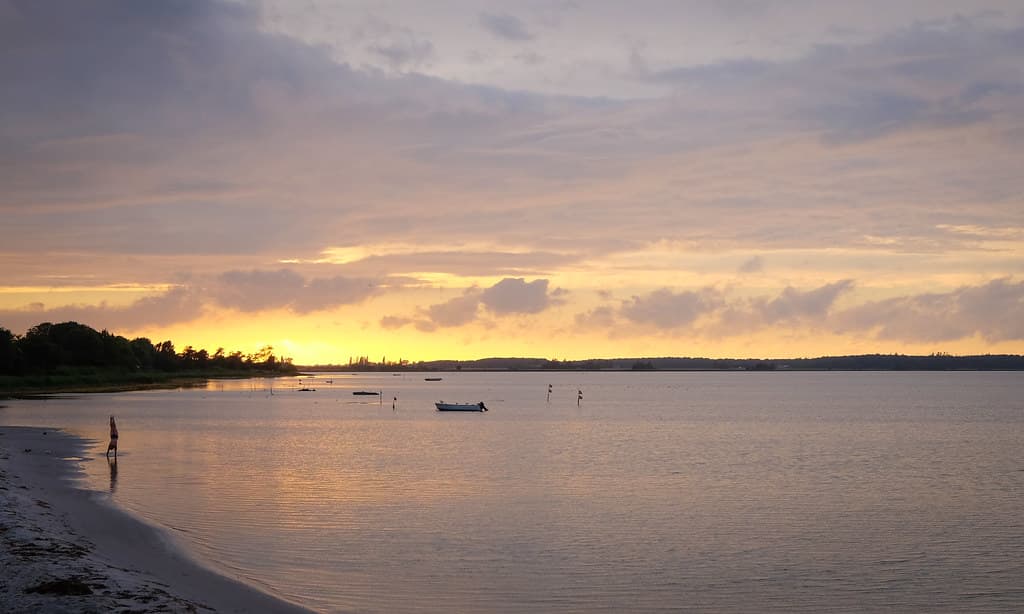
Counting the waves…
Counting the waves…
Askø Strand unfolds along the southern shore of one of Denmark's smallest inhabited islands, a 20-minute ferry ride from Bandholm on Lolland. The beach itself is a low-key affair: a ribbon of fine pale sand backed by tufts of marram grass and wild rose, stretching perhaps 300 meters before dissolving into pebbled inlets. The Baltic here is languid and knee-deep for dozens of meters, striped in shades of teal and slate depending on the wind. You won't find lifeguards, beach bars, or sun-lounger grids—just a simple wooden bench and the occasional rowboat pulled onto shore. The island operates on a different clock. Locals pedal along its four kilometers of narrow roads, stopping to chat by the community garden or the island's single grocer. In summer, a handful of Copenhagen families rent cottages for the week, but even then the strand feels private. Early mornings deliver the best light: fog lifting off the water, cormorants drying their wings on offshore stones, the scent of salt and wild chamomile drifting inland. You'll leave your car at the Bandholm dock—the island permits only residents' vehicles. That constraint becomes a gift. Without engines, you hear waves, birdsong, and the crunch of your own footsteps. The beach asks nothing of you except presence, and in return offers a rare commodity: the freedom to disappear, quietly, for an afternoon.
Places, rentals, tours and events within walking and driving distance of Askø Strand.
Photos
Askø Strand is safe for swimming with calm, shallow waters characteristic of Denmark's inner archipelago beaches. The protected location means waves and currents are minimal, making it suitable for confident swimmers and supervised children. No lifeguard services are available on this tiny island, so exercise normal water safety precautions. Water quality is typically very good. The beach's small size and local character mean you should be self-sufficient regarding safety equipment and first aid supplies.
Visit Askø Strand between June and August for the warmest weather and most reliable ferry connections. July offers peak conditions with longest days and warmest water temperatures, though the island never becomes crowded. Early summer (June) and late summer (late August) provide excellent alternatives with even fewer visitors. Ferry schedules are most frequent during summer months; off-season visits require careful planning as services may be significantly reduced. Weekdays are quieter than weekends even in high season.
Askø is reached by small ferry from either Bandholm on Lolland or Askø's neighboring island Femø. Ferry services are limited, operating on a set schedule that varies by season. The crossing takes approximately 15-20 minutes depending on the route. Once on Askø, which is one of Denmark's smallest inhabited islands, everything is walkable or reachable by bicycle. Check current ferry timetables carefully before planning your visit, as the island's remote nature means transport options are minimal.
Askø has extremely limited facilities reflecting its tiny population of fewer than 50 permanent residents. Accommodation is primarily through private holiday home rentals, which should be booked well in advance. The island has no shops or restaurants, so visitors must bring all necessary supplies from the mainland. Basic services are minimal. This is a destination for self-sufficient travelers seeking genuine isolation and simplicity. The nearest full services are back on Lolland, requiring a ferry journey.
Askø Strand represents one of Denmark's most authentic micro-island beach experiences. With one of the country's smallest island populations, it offers genuine remoteness while remaining technically accessible. The beach provides an uncommercialised, local bathing spot virtually unknown to international tourists. The island's diminutive size means total tranquility and an intimate connection with nature. It's ideal for travelers seeking to escape modern tourism entirely and experience Denmark's archipelago culture in its most undiluted form.