
Counting the waves…
Counting the waves…

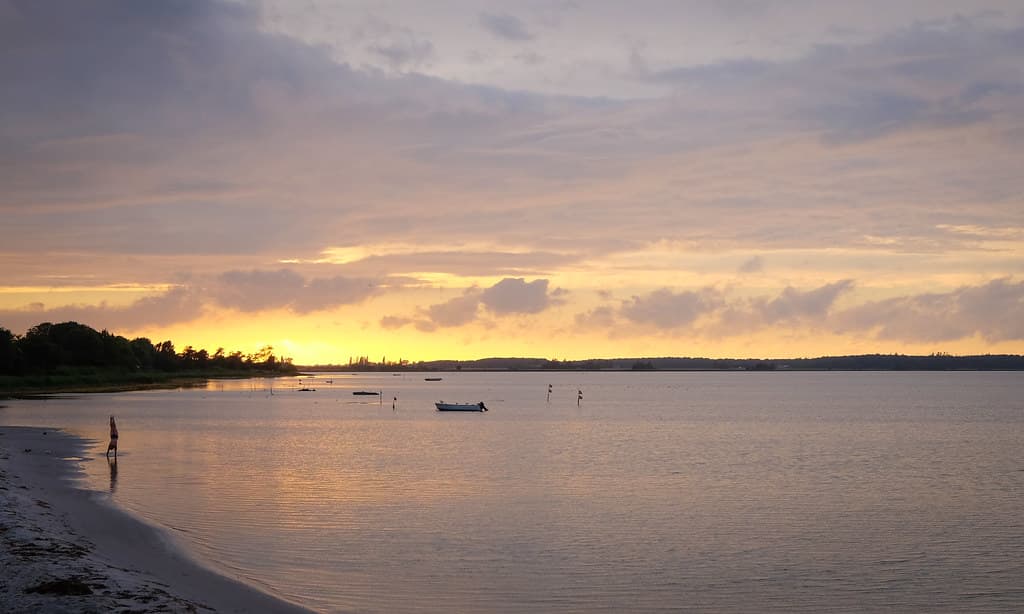
The causeway to Lilleø feels like crossing into a different century—asphalt gives way to gravel, then to a narrow track flanked by wildflowers and scrub. The island itself is barely a kilometer across, its interior a tangle of Scots pine and birch that opens suddenly onto a crescent of fine, butter-colored sand. This is not a beach that announces itself; there are no kiosks, no lifeguard towers, only a modest clearing where a handful of Danish families spread blankets on weekday afternoons in July. The water here is the Baltic at its most placid: shallow for thirty meters, gin-clear over rippled sand, warmed by summer sun to temperatures that make wetsuits a distant memory. You wade in past tufts of eelgrass, watching crabs scuttle sideways, and the silence is broken only by the occasional outboard putting toward Stubbekøbing. In late afternoon, the light turns amber, gilding the pine trunks and casting long shadows across the strand. Timing is everything. Arrive in late May or early September and you may have the entire beach to yourself, the water still swimmable, the blackberry bushes along the causeway heavy with fruit. Lilleø Strand rewards the unhurried—pack a thermos, a paperback, and the understanding that the best beaches are the ones you have to look for twice on the map.
Places, rentals, tours and events within walking and driving distance of Lilleø Strand.
Photos
Lilleø Strand offers generally calm swimming conditions typical of sheltered island shorelines in the Baltic region. The sandy beach provides safe entry for families, though as with most small island beaches, no lifeguard services are available. Swimmers should use personal judgment and supervise children closely. The protected island location typically means gentler waters than exposed coastal beaches, making it suitable for families seeking quiet beach time. Always check local weather conditions, as even sheltered areas can experience changing conditions. The island's small scale and hidden nature create an intimate, low-risk beach environment.
The optimal time to visit Lilleø Strand is during Denmark's summer months from June through August when temperatures are warmest and daylight extends well into evening. These months offer the best conditions for beach activities and swimming in the Baltic waters. For those seeking ultimate solitude at this already hidden beach, weekdays in June or late August provide pleasant weather with minimal crowds. The island location means this beach remains uncrowded even during peak season. Spring and early autumn can be scenic for coastal walks, though water temperatures and weather become less predictable outside summer months.
Reaching Lilleø Strand requires specific local knowledge as this small island beach is often missed in standard travel guides. Access depends on the island's location within the Lolland-Falster coastal area and may involve bridge connections or private access if it's a small inhabited island. Visitors should research current access conditions, as some small Danish islands have restricted access or require permission. A car is typically necessary to reach remote island locations in this region. Contact local tourism offices in the Zealand Region or Lolland-Falster area for specific directions and access information before planning your visit.
Lilleø Strand, being on a small island often missed by broad coastal datasets, has minimal to no on-site facilities. Visitors should plan as if visiting a completely undeveloped beach, bringing all necessary supplies including food, water, sun protection, and beach equipment. The nearest amenities would likely be in larger towns on Lolland or Falster, depending on the island's specific location. This hidden beach is ideal for those who enjoy self-sufficient beach outings and picnicking in pristine, uncommercialized settings. Check local maps for the nearest village or town to purchase provisions before arriving.
Lilleø Strand's uniqueness lies in its island setting and truly hidden character—a beach that most coastal datasets overlook entirely. This obscurity ensures an authentic, undiscovered experience rare in modern European travel. Island beaches offer distinct appeal with their sense of separation from mainland routines and typically more intimate scales. The sandy shoreline provides classic beach enjoyment while the island location creates a special sense of escape. For travelers seeking beaches genuinely off the beaten path in Denmark's coastal landscape, this represents a rewarding find that few international visitors ever experience.