Counting the waves…
Counting the waves…
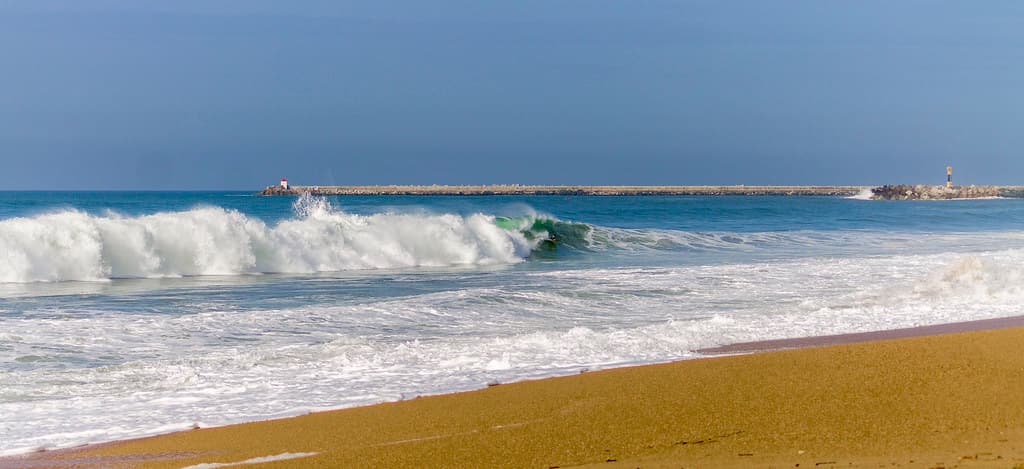
Most drivers shoot straight past Tarnos on the N10, eyes fixed on Hossegor's famed beach breaks or San Sebastián's pintxo bars. That oversight leaves Plage de la Petite Chambre d'Amour to the early-morning dog walkers and the surfers who've learned that transition zones—where one coast bleeds into another—often hold the best-kept secrets. The sand here is wide and firm, ribbed by tides that pull strong but predictable, and backed by dunes that soften the wind. The surf runs smaller than Hossegor's hollow barrels but cleaner than you'd expect this close to the Adour estuary. On a dropping swell, the peaks fan out with enough shoulder for long, carving turns, and the line-up rarely holds more than a dozen bodies. Between sets, you'll notice the light: softer here, filtered through maritime haze that turns late afternoons into a gradient of apricot and steel. When the ocean flattens, the beach reveals its other talent. Low tide exposes tide pools stippled with periwinkles and hermit crabs, and the hard-packed sand invites barefoot walks that stretch for kilometers. To the south, the silhouette of the Pyrénées notches the horizon; to the north, the Landes forest exhales its perpetual scent of resin and wet bark. You came for the waves or the quiet, but you'll remember the in-between—the way this beach refuses to declare allegiance to either coast, and thrives in the liminal space.
Places, rentals, tours and events within walking and driving distance of Plage de la Petite Chambre d'Amour.
Photos
Plage de la Petite Chambre d'Amour is an Atlantic beach with typical Landes coast conditions—moderate to strong surf, currents, and tides. Swimming can be safe during supervised hours in summer when lifeguards are present and conditions permit, but this beach is less developed than major resorts and may not always have full supervision. The beach appeals more to experienced swimmers and surfers comfortable with ocean conditions. Always check for flags and warnings, avoid swimming alone, and be aware that Atlantic beaches have stronger currents than Mediterranean ones. Shore breaks can be powerful, making it better suited for surfing than leisurely swimming for families.
For surfing, autumn through spring offers consistent Atlantic swells, though water is cooler (wetsuits essential). Summer (June-September) provides warmest water and weather, suitable for both surfing and beach walks, though waves may be smaller. The beach's quieter nature makes it ideal for peaceful visits year-round, particularly during shoulder seasons (May-June, September-October) when you'll find fewer crowds than at nearby Hossegor. Sunset walks are beautiful throughout the year. Winter brings powerful surf for experienced riders but cold, windy conditions. Being a transition zone between Landes and Basque coasts, it avoids the extreme crowds of famous surf spots during peak season.
The beach is located in Tarnos, near the Landes-Basque Country border. By car, take the D810 coastal road with parking available near beach access points (check for any seasonal fees). The nearest airport is Biarritz (approximately 10-15km), making it easily accessible for fly-in visitors. From Bayonne or Biarritz, drive north on the coastal road following signs toward Tarnos. Public transport is limited; a car or bicycle is recommended. The beach sits between more famous destinations, so GPS coordinates or detailed maps help. Local buses may connect Tarnos to larger towns but beach access typically requires walking from stops.
As a quieter, less developed beach, immediate beachfront facilities are minimal compared to major resorts. Tarnos town (nearby) offers restaurants, cafés, and shops, though not directly on the beach. Accommodation options include holiday rentals, small hotels, and campgrounds in Tarnos and surrounding areas. Many visitors stay in nearby Biarritz, Bayonne, or Capbreton and visit as a day trip. The area suits those seeking authentic, non-commercialized beach experiences. Self-catering is common. For extensive dining and lodging, the larger resorts north (Hossegor, Capbreton) and south (Biarritz) are within short driving distance and offer full services.
This beach represents the quieter, often overlooked stretches between famous surf destinations. Its location at the Landes-Basque coast transition means it escapes the intense crowds of Hossegor or Biarritz while offering similar Atlantic surf conditions. The name "Petite Chambre d'Amour" (Little Room of Love) adds romantic charm, though it's far less developed than its namesake beach near Anglet. It appeals to surfers seeking uncrowded waves, walkers wanting scenic coastal paths, and visitors who prefer authentic, low-key beach experiences over resort atmospheres. The wide sandy beach and natural setting provide peaceful alternatives to commercialized coastlines.