Counting the waves…
Counting the waves…
A refined fusion of water purity, environmental stability, and communal vibrancy for Plage de Penthièvre.
View MethodologyAnalyzed via live sensors and environmental data.
Wave height, wind, and atmospheric stability.
Live footfall and crowd balance metrics.
Community reviews and curated sentiment.
“Wind whips across the narrow strip of sand connecting mainland Brittany to the Quiberon Peninsula, carrying the salt tang of two bays. On Plage de Penthièvre, families build sandcastles while surfers paddle into rolling…”
Limited recent visitor reports — live OBI telemetry is your best guide for current conditions.
You stand on a geological thread—a fragile sand bridge barely wider than a football pitch, with the sheltered waters of Quiberon Bay lapping to the east and the untamed Atlantic pounding to the west. Plage de Penthièvre sprawls along this isthmus, a sweep of tawny sand where tide pools glisten at low water and the horizon splits between calm and chaos. The 18th-century fort watches from its dune, a somber reminder that this strategic neck of land has always mattered.
The beach answers to the wind. Westerlies drive chest-high swells onto the shore, drawing surfers who wax their boards in parking lots before jogging across the soft sand. When the breeze shifts, kite flyers and families claim the flats, spreading picnic blankets near the dune grass that shivers in the salt air. The water temperature hovers cool year-round, but wetsuits are a badge of honor here, not an apology.
 Credit: Unsplash
a rocky beach with a rock formation in the water
 Credit: Unsplash
a beach filled with lots of people on top of it
West-facing beach breaks year-round
Historic ramparts above the beach
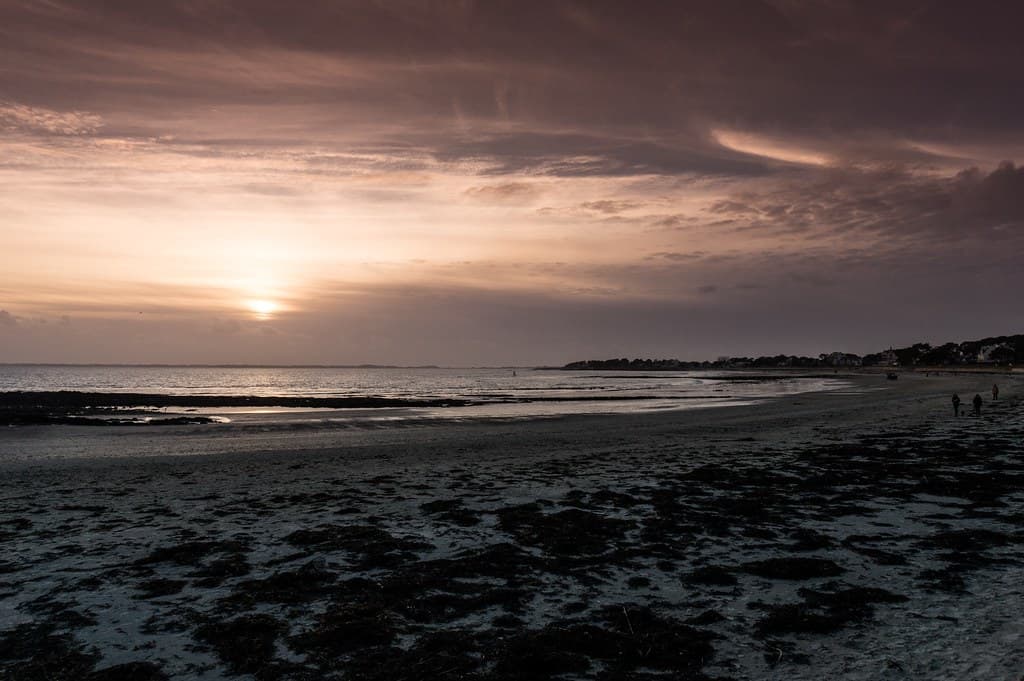
Golden hour over dual bays
Where it is
Plage de Penthièvre
Saint-Pierre-Quiberon, Morbihan, France
47.557800°, -3.135300°
Weather
Loading…
Swell
—
Temp
Warm · Restorative
UV Index
Moderate
Wind
—
Tidal State
Last known
Max Sunlight
—
Ideal Shade
—
May - Sep (Peak)
Jan - Dec (Off-season)
Historical data suggests peak visibility and stable sea temperatures occur during the prime visitation window.
Select a category to load nearby places.
Unlock restaurants, luxury stays and curated maritime experiences within 2km
Plage de Penthièvre faces the Atlantic on the western side of the Quiberon isthmus, which means it can experience strong currents and larger waves, particularly popular with surfers. Swimming conditions vary greatly depending on weather and tides. During summer, lifeguards supervise the beach, and flags indicate safe swimming zones. Families with young children may prefer calmer days or the more sheltered eastern beaches. Always check local conditions and respect posted warnings, as Atlantic swells can be powerful even on seemingly calm days.
Plage de Penthièvre is accessible year-round, with each season offering different experiences. Summer (June-August) provides the warmest weather and supervised swimming, though it's busiest. Spring and autumn offer milder temperatures, fewer crowds, and excellent conditions for coastal walks and surfing. The beach is particularly stunning at sunset throughout the year. Winter attracts surfers and storm watchers who appreciate dramatic Atlantic waves. For comfortable beach weather and swimming, visit between June and September, when temperatures are warmest and facilities are fully operational.
Plage de Penthièvre is located on the narrow isthmus connecting the Quiberon Peninsula to mainland Brittany. By car, take the D768 road from Plouharnel; the beach is directly accessible from this main route. Several parking areas are available near the beach, though spaces fill quickly in summer. The beach is approximately 30km from Auray and 50km from Vannes. Public buses connect Quiberon town to Saint-Pierre-Quiberon during summer months. Cycling is popular along the isthmus, with designated paths offering safe, scenic access.
Saint-Pierre-Quiberon, the nearest village, offers various restaurants, cafés, and accommodations within walking or short driving distance of Plage de Penthièvre. You'll find traditional crêperies, seafood restaurants, and casual beachside eateries. Basic beach amenities like showers and toilets are available during summer. For accommodations, options range from campsites to vacation rentals and small hotels in Saint-Pierre-Quiberon and nearby Quiberon town. Small shops and bakeries in the village provide supplies for beach picnics. During peak season, booking restaurants and lodging in advance is recommended.
Plage de Penthièvre's location on the narrow isthmus creates a unique geographical experience—you can literally see both coasts within minutes. The wild Atlantic side contrasts dramatically with the calmer eastern shores. This strategic position has historical significance; the area features Fort de Penthièvre, a 18th-century fortress overlooking the beach. The beach offers exceptional sunset views over the ocean while the isthmus itself is a natural corridor between two distinct coastal environments, making it both a scenic gateway and a distinctive geographical landmark in Brittany.
Photos