Counting the waves…
Counting the waves…
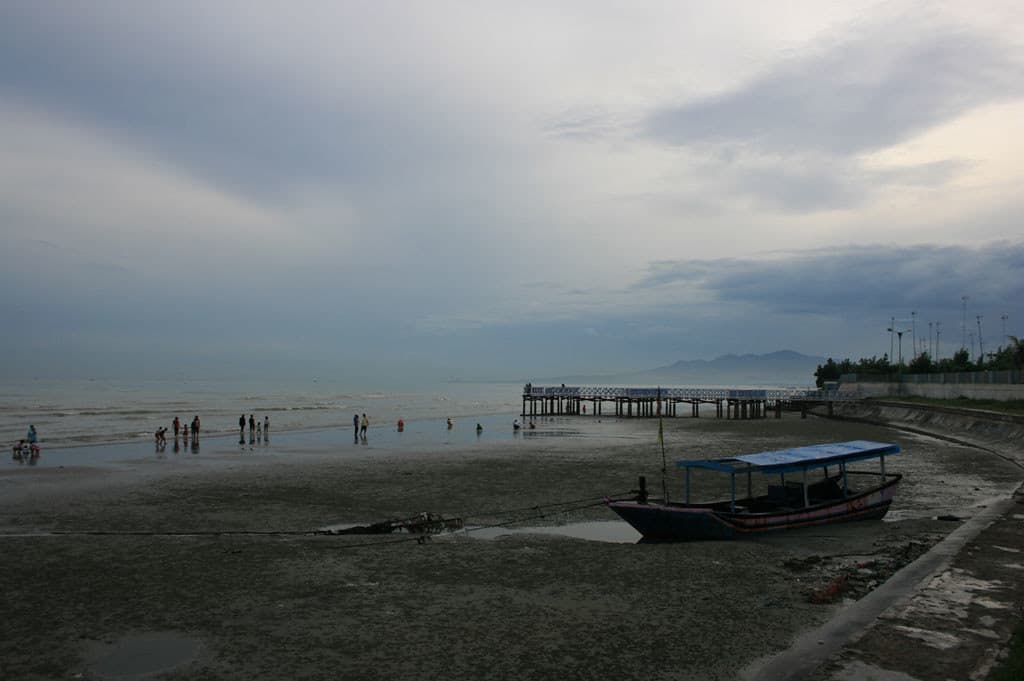
You won't find Pasir Kencana on most beach apps, and that's part of its charm. This slim ribbon of sand sits where Pekalongan's batik quarter meets the Java Sea, a place where the city's textile heritage brushes against the tide. Fishermen mend nets in the early morning while vendors grill jagung bakar over coconut-husk coals, the smoke mingling with the humid coastal breeze. The sand here carries a beige-gray tone, packed firm enough for evening football matches and lined with casuarina trees that lean inland from decades of sea wind. Low tide reveals a broad expanse of shallow flats where local families gather, children splashing in ankle-deep water while parents set up portable chairs. The shoreline stretches long and flat, better suited for wading than swimming, with tidal pools that trap tiny fish and hermit crabs. By four in the afternoon, the light softens, and the entire beach reorients toward the western horizon. Motorbikes arrive carrying couples and clusters of teenagers, all positioning themselves for the slow descent of the sun into the Java Sea. The beach pulses with the rhythm of Pekalongan itself—neither polished nor wild, but lived-in. Street vendors sell es kelapa muda and pisang goreng from carts with peeling paint. A few warungs perch just off the sand, their plastic stools facing the water. You're here not for seclusion but for the ordinary grace of a working coastline, where the sea belongs to everyone and sunset is the city's nightly ritual.
Places, rentals, tours and events within walking and driving distance of Pasir Kencana Beach.
Photos
Swimming conditions at Pasir Kencana Beach are generally calm, making it suitable for families with children. The beach faces the Java Sea with typically gentle waves, though conditions vary with tides and seasons. As with any beach, supervise children closely and avoid swimming during rough weather or high tide. The beach is within Pekalongan city limits, so emergency services are accessible. Local vendors and other beachgoers are usually present during daylight hours. Always check current conditions with locals before entering the water.
Pasir Kencana Beach can be visited year-round due to Central Java's tropical climate. The dry season (May to September) typically offers the most pleasant weather with less rainfall and clearer skies, ideal for beach activities and sunset viewing. Weekday mornings are quietest for a peaceful experience. Late afternoons attract locals and visitors for sunset watching, a highlight of this beach. The wet season (October to April) brings occasional afternoon showers but doesn't necessarily prevent beach visits. Weekends and Indonesian holidays see larger crowds.
Pasir Kencana Beach is located in urban Pekalongan, approximately 3-4 km from the city center. You can reach it by car, motorcycle, or local transportation like becak (pedicab) or ojek (motorcycle taxi). The beach is accessible via Jalan Yos Sudarso along Pekalongan's northern coast. Parking is typically available near the beach area, though spaces may be limited during peak hours and weekends. Many visitors use ride-hailing apps like Gojek or Grab for convenient access. Ask locals for 'Pantai Pasir Kencana' if directions are unclear.
As an urban beach, Pasir Kencana offers basic amenities including local food vendors and warungs (small restaurants) selling Indonesian snacks, fresh coconuts, and simple meals. Street food options typically include grilled corn, fried snacks, and seafood. Public facilities are basic, so manage expectations accordingly. For more dining choices and lodging, Pekalongan city center is just minutes away, offering hotels, guesthouses, and restaurants. The beach itself is primarily a day-visit destination rather than an overnight stay location. Bring cash as card payment may not be widely accepted.
Pasir Kencana Beach doesn't always appear on digital maps because it's a local urban beach rather than a major tourist destination. Some mapping services may list it under alternative names or categorize it as part of Pekalongan's waterfront rather than as a distinct beach. The area has developed organically as a community gathering spot rather than being formally designated as a tourist beach. When searching, try variations like 'Pantai Pasir Kencana Pekalongan' or look for the northern coastal road (Jalan Yos Sudarso). Locals are familiar with it and can provide directions.