Counting the waves…
Counting the waves…
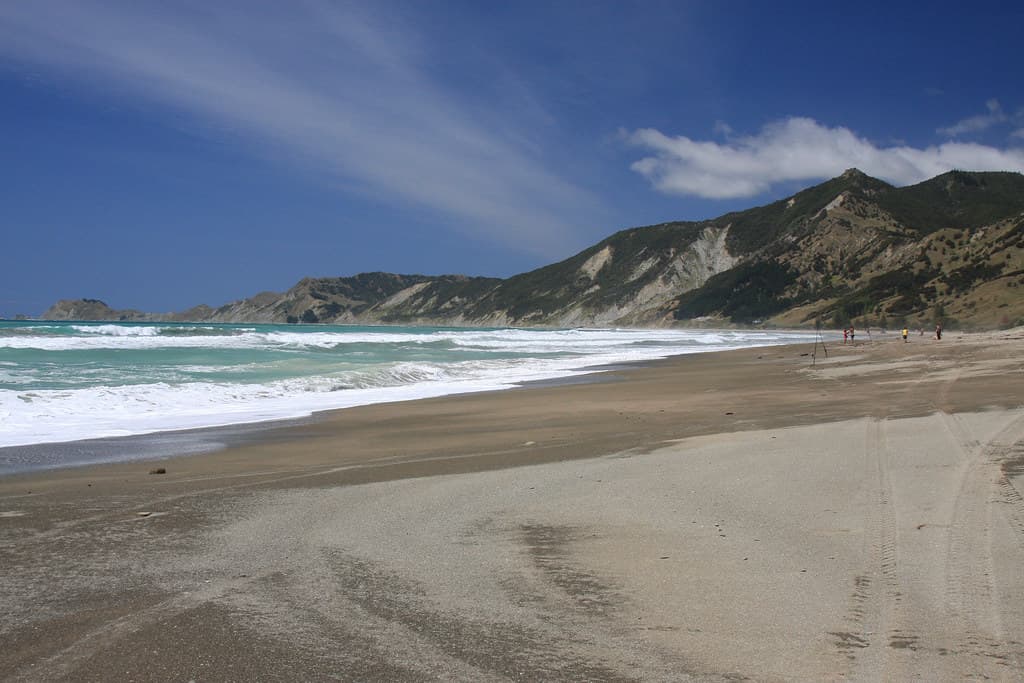
You'll spot Hauiti Beach from State Highway 35 as it hugs the coastline between Anaura and Tokomaru Bay—a stretch of charcoal sand that seems to go on for kilometers, backed by scrubby dunes and the occasional macrocarpa windbreak. The shore drops away sharply; waves detonate close to the sand, sending spray six feet high. It's a beach for walking rather than swimming, the undertow fierce enough to command respect. Driftwood accumulates here in extraordinary volume—entire trunks stripped of bark, bleached silver by salt and sun, arranged in chaotic sculptures by winter storms. Between the logs, you'll find pumice pebbles, some small as marbles, others fist-sized, all buoyant enough to have drifted here from volcanic vents hundreds of miles north. Oystercatchers patrol the wrack line, their orange beaks bright against the monochrome palette. The settlement of Hauiti sits just inland, a scattering of houses and a marae where smoke curls from hangi pits on weekends. Locals launch boats through the surf on calm mornings, timing the sets, motors tilted high until they're past the break zone. You'll have long stretches of sand to yourself, the only footprints those of horses ridden down from nearby farms, their hoofprints filling with seawater as the tide advances.
Places, rentals, tours and events within walking and driving distance of Hauiti Beach.
Photos
Hauiti Beach is generally suitable for swimming during calm conditions, but like most East Coast beaches, it's unpatrolled and can experience variable surf and currents. Check conditions before entering the water and swim between the flags if lifeguards are present during summer holidays. The beach is relatively sheltered, making it safer than more exposed coastlines. Always supervise children closely, avoid swimming alone, and be cautious after heavy rainfall when water quality may be compromised. Local knowledge is invaluable for understanding specific hazards.
The best time to visit Hauiti Beach is during summer months (December to February) when weather is warmest and most reliable, though this is also the budget travel season with fewer tourists than popular destinations. Autumn (March-May) offers pleasant temperatures and good weather. The beach is scenic year-round, but winter can be quite cool and wet. Early morning and late afternoon provide excellent light for photography. Weekdays are quieter than weekends, and you'll likely have this hidden gem largely to yourself regardless of when you visit.
Hauiti Beach is located on State Highway 35 (the Pacific Coast Highway) between Anaura Bay and Tokomaru Bay, approximately 90 minutes north of Gisborne. The beach is accessible by car via a turnoff from SH35. The road is sealed most of the way, though the final approach may be gravel. This remote location means having your own vehicle is essential, as public transport options are extremely limited in this region. Ensure you have sufficient fuel, as service stations are sparse along the East Cape route.
Hauiti Beach has very limited facilities due to its remote location. The nearest towns with accommodation and dining options are Tokomaru Bay (south) and Te Puia Springs (north), though these are small settlements with basic services. Most visitors bring their own food and supplies from Gisborne. Camping may be possible in the area, but facilities are minimal. For a wider range of accommodation including motels, holiday parks, and restaurants, base yourself in Tolaga Bay or Tokomaru Bay and visit Hauiti as a day trip.
Hauiti Beach stands out for its pristine isolation and authentic rural character along the East Cape route. Unlike busier beaches, it offers a genuine sense of discovery and solitude, perfect for families seeking an uncrowded coastal experience. The beach sits between two better-known bays, giving it a hidden quality that most tourists bypass. Its location on the Pacific Coast Highway makes it an ideal stop for travellers exploring the scenic East Cape circuit, offering stunning coastal scenery and a glimpse into New Zealand's less-visited regions with strong Māori heritage.