Counting the waves…
Counting the waves…
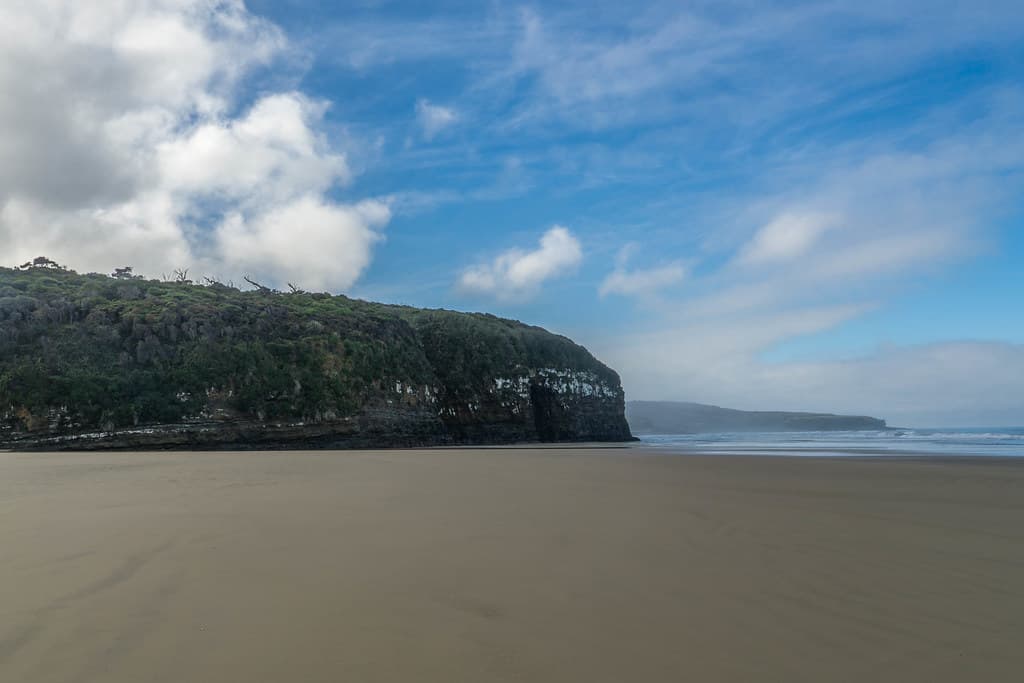
The tide pulls back to reveal something astonishing: entire petrified logs and stumps from a Jurassic forest, their grain and growth rings still visible in stone. You crouch on the wave-cut platform, tracing your fingers along fossilized wood that turned to rock when dinosaurs walked the earth. Seawater fills the crevices between ancient trunks, and kelp drapes over stone that was once a towering conifer. Consistent swells roll in from Antarctica, peeling along the rocky point where surfers in thick wetsuits carve long lefts. The water temperature hovers around 12 degrees Celsius year-round, and the wind carries the smell of bull kelp and salt. Hector's dolphins often appear in the bay, their small dorsal fins cutting through the lineup, while fur seals lounge on offshore rocks, indifferent to the cold. As evening arrives, you position yourself behind the viewing barrier and wait. Yellow-eyed penguins—hoiho, among the world's rarest—emerge from the waves, hesitating in the shallows before waddling up the beach toward their nesting sites in the coastal scrub. They shake, preen, and call to each other in low trumpeting voices, utterly unaware of your presence twenty meters away.
Places, rentals, tours and events within walking and driving distance of Curio Bay Beach.
Photos
Swimming at Curio Bay is generally not recommended due to strong currents, cold water temperatures, and the rocky coastline. The beach is more suited for exploring rock pools and viewing the petrified forest at low tide. If you wish to swim, Porpoise Bay next door offers safer, more sheltered conditions. Always check tide times and weather forecasts before visiting, wear appropriate footwear for rocky terrain, and keep a safe distance from wildlife including seals and sea lions that frequent the area.
The best time to visit is during low tide when the 180-million-year-old petrified forest is exposed and visible on the rock platform. Summer months (December-February) offer the best weather and longer daylight hours, though the area can be visited year-round. Early mornings or late afternoons provide excellent light for photography. For wildlife encounters, yellow-eyed penguins return to shore at dusk, while Hector's dolphins are often spotted throughout the day. Winter months see fewer crowds but harsher weather conditions.
Curio Bay is located in the remote Catlins region of Southland, approximately 2.5 hours drive south of Invercargill or 3 hours from Dunedin via the Southern Scenic Route. The beach is accessed via Curio Bay Road off the main highway. Roads are sealed but can be narrow and winding. A rental car is essential as public transport doesn't service this area. The nearest township with basic services is Waikawa, just minutes away. Allow extra travel time for photo stops along the scenic route.
Accommodation options include the Curio Bay Holiday Park offering cabins and campsites right by the beach, and various self-contained cottages in Waikawa village. The Curio Bay Salthouse offers dining with ocean views during operating hours. For more dining options, you'll need to travel to nearby towns like Tokanui or pack your own supplies. The area is remote, so stock up on groceries in larger towns like Invercargill or Balclutha before arriving. Self-catering is recommended given limited restaurant availability in the immediate area.
Curio Bay's petrified forest is one of the world's most extensive and best-preserved Jurassic fossil forests, dating back 180 million years. At low tide, you can walk among fossilized tree stumps, logs, and root systems embedded in the rock platform, representing an ancient subtropical forest. The fossils include tree species related to modern kauri and Norfolk pines. This rare geological feature offers a glimpse into New Zealand's prehistoric landscape when it was part of Gondwana. Viewing is weather and tide-dependent, so check local tide charts before visiting.