
The approach through farmland gives no hint of what's coming: then the land drops away and you're standing above a beach that looks assembled by tectonic argument. Boulders, platforms of layered rock, tide pools carved into sedimentary shelves—Fossil Point wears its geological history on the surface. The rock strata tilt and fold, recording ancient seabed compressed into stone, now cracked and pitted by salt and storm.
“A geologically dramatic beach where ancient rock layers meet powerful surf, offering raw coastal scenery near the more famous Wharariki Beach.”
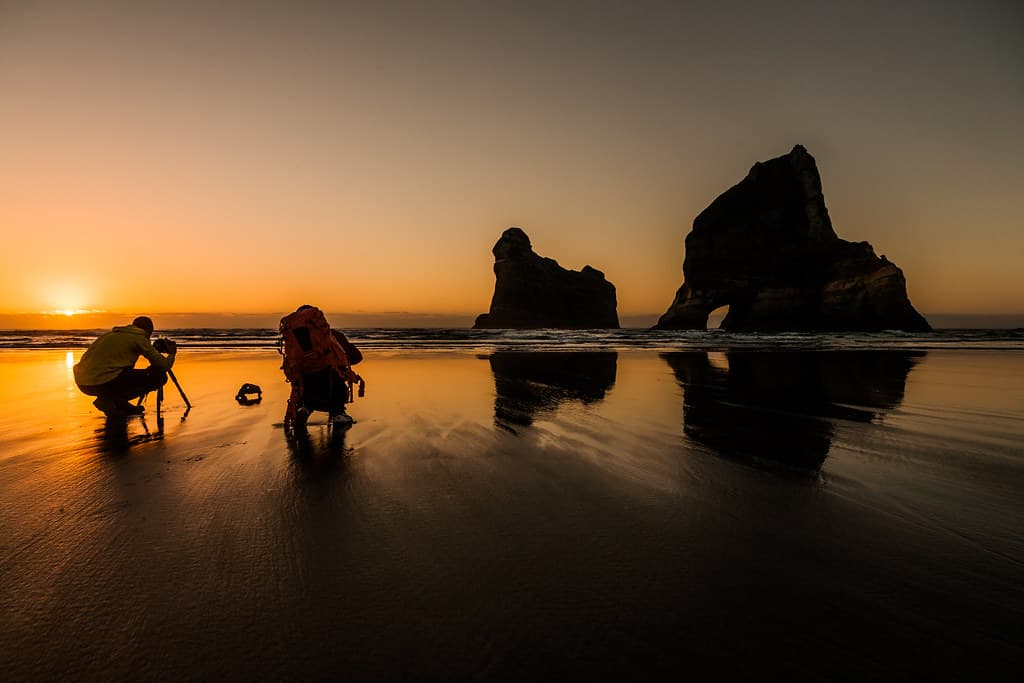 Credit: Flickr
Fossil Point Beach — photo by sandeepachetan.com
This is not a swimming beach. The ocean arrives with intent here, waves exploding against rock faces, spray lifting in sheets. On big swell days, the entire shoreline becomes percussion—boom and hiss, the constant movement of water reshaping stone molecule by molecule. You'll find sea caves undercut into cliffsides, arches framing pieces of horizon, and if you time it right, tide pools teeming with anemones and crabs.
The name promises fossils, and patient searching reveals them: shell impressions, marine organism traces, the compressed memories of Oligocene seas. But the real draw is the wildness, the sense that this coast remains uninterested in human comfort. Photographers work the angles—rock textures against sky, wave action frozen mid-explosion, the interplay of light on wet stone. You leave windblown and slightly humbled.


