Counting the waves…
Counting the waves…
A refined fusion of water purity, environmental stability, and communal vibrancy for New Chums Beach.
View MethodologyAnalyzed via live sensors and environmental data.
Wave height, wind, and atmospheric stability.
Live footfall and crowd balance metrics.
Community reviews and curated sentiment.
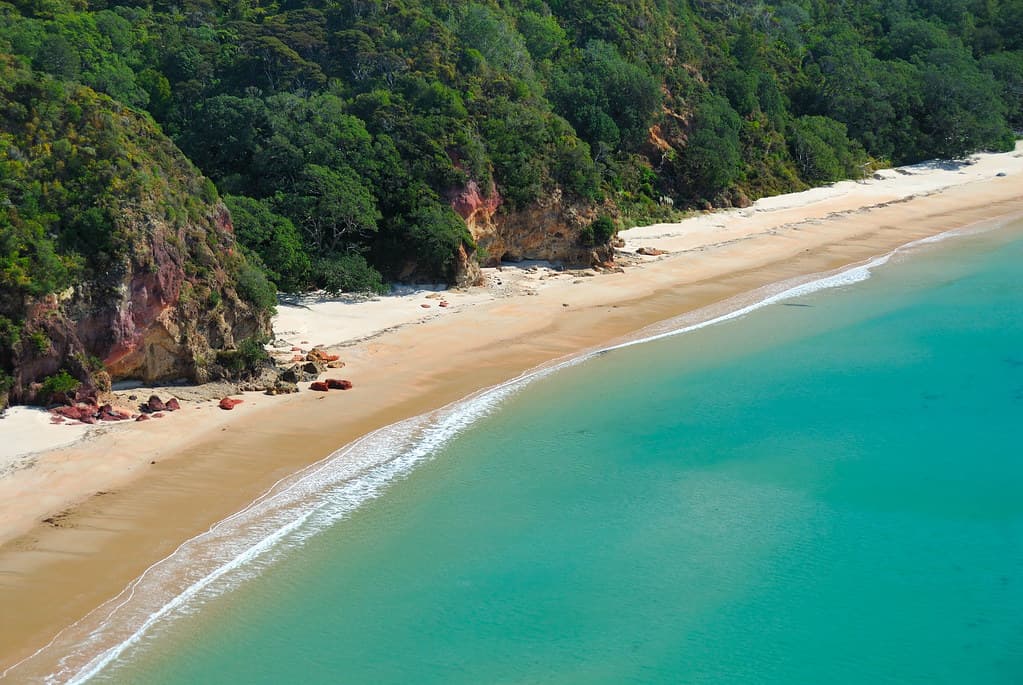
“Your calves will feel the climb over the headland from Whangapoua, but the reward is a sweeping crescent of pale sand backed by native forest—no houses, no roads, just the Tasman Sea and the rustling canopy overhead.”
Limited recent visitor reports — live OBI telemetry is your best guide for current conditions.
The twenty-minute trek from Whangapoua Estuary delivers you to a shore that has refused every developer's advance. Pohutukawa roots grip the cliff face above the sand, their gnarled limbs casting shadows that shift with the afternoon sun. The beach curves for nearly a kilometer, its surface marked only by the footprints of earlier arrivals and the occasional driftwood log bleached silver by salt and time.
Wade into the shallows and feel the temperature drop as currents from deeper water mix with sun-warmed bands near shore. The seabed slopes gradually, ridged sand visible through the shifting surface. Tidal pools collect in the rocks at the southern end, where small fish dart between anemones anchored to stone.
 Credit: Unsplash
coastal dunes and beach at sunset
 Credit: Unsplash
a body of water with a hill in the background
Through native pohutukawa forest
Gradual entry, shifting temperatures
Unspoiled coastal vistas
Prime Visitation
Less Crowds|Best Weather
Where it is
New Chums Beach
New Chums Beach, Waikato Region, New Zealand
-36.688500°, 175.621000°
Weather
Loading…
Swell
—
Temp
Warm · Restorative
UV Index
Moderate
Wind
—
Tidal State
Last known
Max Sunlight
—
Ideal Shade
—
Jan - Dec (Peak)
Mar - Nov (Off-season)
Less Crowds|Best Weather
Near New Chums Beach
Explore dining, stays, nightlife, and activities near New Chums Beach in New Chums Beach, New Zealand. Every listing below is a real place linked to this beach — open a card for reviews, maps, and booking options.
Food, cafés, and dining close to New Chums Beach — curated from places linked to this beach.
Stays and lodging options near New Chums Beach for your beach trip.
Select a category to load nearby places.
Unlock restaurants, luxury stays and curated maritime experiences within 2km
Swimming at New Chums Beach can be safe in calm conditions, but caution is essential as there are no lifeguards or facilities. The beach is relatively sheltered, but ocean conditions vary with tides, swell, and weather. Rips and currents can develop, particularly near the headlands at either end. Always assess conditions before entering the water and never swim alone. The beach's remote location means help is not readily available in emergencies. Strong swimmers will generally find it manageable during settled weather, but families with young children should exercise extra vigilance.
To experience New Chums Beach with fewer crowds, visit during autumn (March-May) or spring (September-November) on weekdays. Early morning arrivals, especially before 9am, offer the most solitude even during summer. Avoid public holidays and January school holidays when visitor numbers peak. Winter months (June-August) are quietest but weather can be unpredictable and water cold. The beach's remote, walk-in access naturally limits crowds compared to road-accessible beaches, but its fame as one of New Zealand's most beautiful beaches means it's never truly deserted during good weather.
New Chums Beach is accessed only by foot from Whangapoua Beach. Drive to Whangapoua (about 30 minutes from Whitianga via Whangapoua Road), park at the northern end near the estuary, and follow the well-marked coastal track. The walk takes 20-30 minutes one way over an easy-to-moderate trail that includes some rocky sections, tree roots, and a small hill. Wear sturdy footwear as the path can be slippery when wet. The track is unsuitable for strollers or wheelchairs. Check tide times, as some sections near rocks are easier at lower tide.
New Chums Beach is completely undeveloped with absolutely no facilities—no toilets, shops, cafes, or freshwater. This pristine state is part of its protected charm. Visitors must bring everything they need, including drinking water, food, and sun protection, and must carry out all rubbish. The nearest facilities are back at Whangapoua Beach, where there are basic public toilets. For food, cafes, and shops, you'll need to travel to Whitianga or Coromandel Town. Plan ahead and pack appropriately, treating this as a wilderness beach experience requiring self-sufficiency.
New Chums Beach is renowned as one of New Zealand's last truly undeveloped and unspoiled beaches. Its protection from development, walk-in-only access, and pristine natural state make it exceptional. The beach features stunning white sand, crystal-clear water, and native pohutukawa forest extending to the shoreline—a rare sight. Its photogenic beauty has earned international recognition in travel publications and social media. The combination of exclusivity (requiring effort to reach), environmental protection, and raw natural beauty creates an experience increasingly rare in modern New Zealand, making it a bucket-list destination for beach lovers.
Photos