Counting the waves…
Counting the waves…
A refined fusion of water purity, environmental stability, and communal vibrancy for Port Jackson Beach.
View MethodologyAnalyzed via live sensors and environmental data.
Wave height, wind, and atmospheric stability.
Live footfall and crowd balance metrics.
Community reviews and curated sentiment.
“You've driven as far as the Coromandel allows, thirty kilometers of gravel beyond Colville delivering you to this windswept arc of beach. The campground sits behind the dunes, and Great Barrier Island fills the horizon…”
Limited recent visitor reports — live OBI telemetry is your best guide for current conditions.
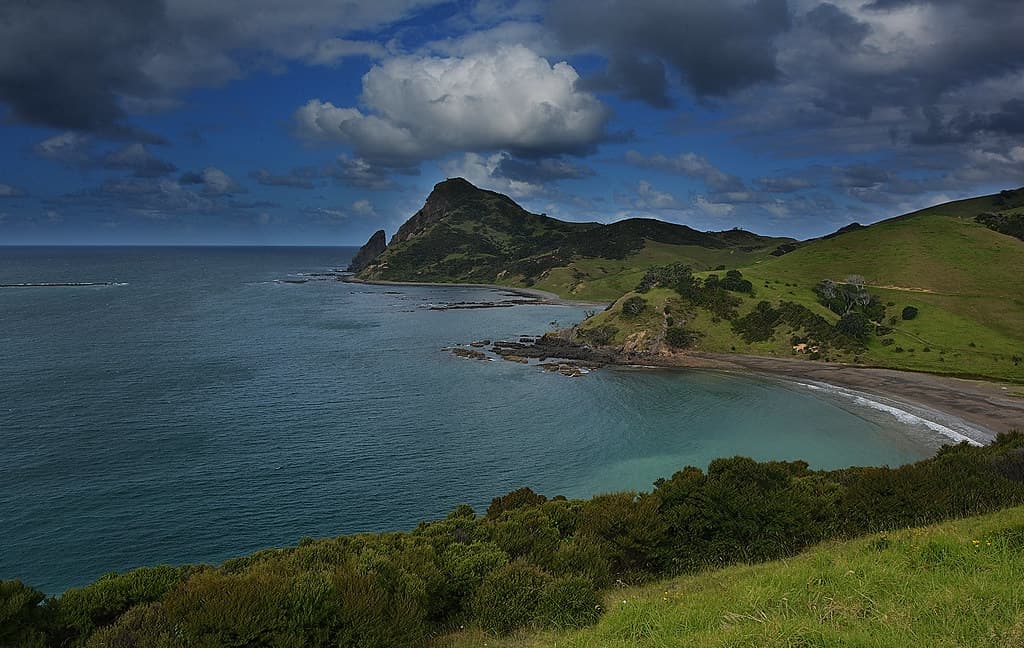
Port Jackson feels terminal in the best sense: the road ends at a turning circle, and beyond lies only beach, headland, and the walking track to Stony Bay. The sand runs pale and coarse, swept by winds that funnel through the gulf and pile driftwood against the foredune. You'll camp beneath macrocarpa that lean permanently landward, their branches sculpted by decades of onshore gales, while waves arrive from the northeast with the gulf's full fetch behind them.
The beach curves gently between rocky points, widening to over a hundred meters at low tide when the slope flattens and tidal pools appear. Great Barrier Island dominates every seaward view, close enough that you can distinguish ridgelines and valleys, its mass either softened by humidity or sharpened by southerly clarity depending on weather. Local boats occasionally round the northern headland from Fletcher Bay, seeking calmer water, their hulls dipping as they cross the bar where swells steepen briefly before spreading across the bay.
 Credit: Unsplash
coastal dunes and beach at sunset
 Credit: Unsplash
a body of water with a hill in the background
Coast-hugging trail continues north
Island views across full gulf
Exposure creates challenging swimming
Prime Visitation
Best Weather|Less Crowds
Where it is
Port Jackson Beach
Port Jackson, Waikato Region, New Zealand
-36.486900°, 175.373600°
Weather
Loading…
Swell
—
Temp
Warm · Restorative
UV Index
Moderate
Wind
—
Tidal State
Last known
Max Sunlight
—
Ideal Shade
—
Jan - Dec (Peak)
Mar - Nov (Off-season)
Best Weather|Less Crowds
Select a category to load nearby places.
Unlock restaurants, luxury stays and curated maritime experiences within 2km
Swimming at Port Jackson Beach requires caution as it's a remote, unpatrolled beach at the northern tip of the Coromandel Peninsula. Conditions vary with tides, winds, and swells. The beach can experience currents and changing conditions due to its exposed coastal position. Always assess conditions before entering the water and swim only in calm weather. There are no lifeguards or immediate emergency services nearby. The remote location means help is distant, so exercise appropriate judgment and never swim alone.
Visit Port Jackson Beach during summer (December-February) for the best weather, though the beach offers appeal year-round for nature lovers. The remote location means fewer crowds in all seasons. Sunset viewing is particularly spectacular from this northern vantage point. Autumn (March-May) can offer mild weather with minimal visitors. Check weather forecasts before traveling, as the unsealed road access can become challenging in heavy rain. Early mornings and late afternoons provide excellent lighting for photography and wildlife watching.
Port Jackson Beach requires driving the entire length of Port Jackson Road from Colville, approximately 30 kilometers of narrow, winding, mostly unsealed road. The journey takes 60-90 minutes from Colville depending on conditions. A sturdy vehicle is recommended, though regular cars can manage in dry conditions. Drive carefully and yield at narrow sections. There's no public transport. The road ends at Port Jackson, making it truly remote. Fill up with fuel in Coromandel Town or Thames before heading north.
Port Jackson offers very limited facilities, primarily Department of Conservation camping grounds that are popular with campers and those seeking wilderness experiences. Basic campsite amenities are available but no shops, restaurants, or commercial accommodations exist at Port Jackson itself. Visitors must bring all food, water, and supplies. The nearest services are in Colville (limited) or Coromandel Town (comprehensive). Self-sufficiency is essential. Book camping spots in advance during peak summer season, as spaces fill quickly despite the remote location.
Port Jackson Beach sits at the absolute northern tip of the Coromandel Peninsula, offering expansive coastal views rarely found elsewhere. Its extreme remoteness creates a true wilderness beach experience with minimal development or crowds. The location provides stunning perspectives of the Hauraki Gulf and surrounding coastline. It's a launching point for hiking the coastal walkway and exploring New Zealand's most isolated accessible beaches. The combination of wide sandy shores, dramatic coastal scenery, and camping appeal attracts adventurous travelers seeking solitude and natural beauty.
Photos