Counting the waves…
Counting the waves…
A refined fusion of water purity, environmental stability, and communal vibrancy for Thornton Bay Beach.
View MethodologyAnalyzed via live sensors and environmental data.
Wave height, wind, and atmospheric stability.
Live footfall and crowd balance metrics.
Community reviews and curated sentiment.
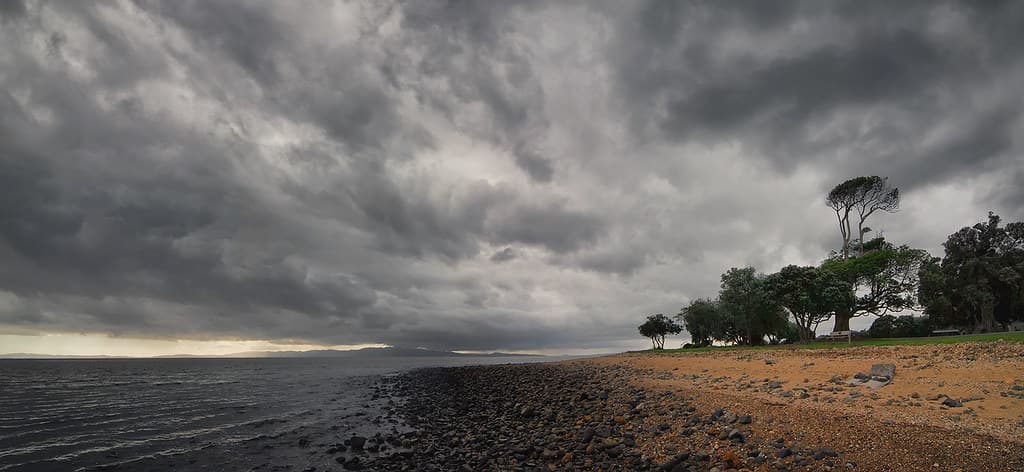
“The beach unfolds in shades of grey and tan—pebbles worn smooth by tides, driftwood bleached silver, water that mirrors the sky's mood. You'll park roadside and pick your way across stones to the water's edge.”
Limited recent visitor reports — live OBI telemetry is your best guide for current conditions.
Thornton Bay Beach announces itself as you round the coastal road's curve—a sweep of pebbles and a narrow reserve squeezed between asphalt and Firth. The stones range from golf-ball to fist-sized, tumbled smooth by decades of wave action. Walking across them produces a distinctive crunch and rattle, the sound of constant geological revision. At the high-tide line, driftwood logs lie scattered like discarded sculptures, their surfaces weathered to bone-white and grey.
The Firth stretches west toward the Kaimai Range, a broad expanse of water that shifts hourly with weather and light. On still days, the surface becomes glass, perfectly reflecting clouds and distant hills. When wind arrives from the north, small waves lap the pebbles with rhythmic persistence. The beach has an exposed, elemental quality—minimal vegetation, maximum sky, nothing between you and the weather rolling across the Firth.
 Credit: Unsplash
coastal dunes and beach at sunset
 Credit: Unsplash
a body of water with a hill in the background
Weathered wood, Firth backdrop compositions
Shoreline walking, stone collection
Road-trip breaks, water views
Prime Visitation
Anytime|Budget Travel
Where it is
Thornton Bay Beach
Thornton Bay, Waikato Region, New Zealand
-37.016400°, 175.526900°
Weather
Loading…
Swell
—
Temp
Warm · Restorative
UV Index
Moderate
Wind
—
Tidal State
Last known
Max Sunlight
—
Ideal Shade
—
Jan - Dec (Peak)
Mar - Nov (Off-season)
Anytime|Budget Travel
Select a category to load nearby places.
Unlock restaurants, luxury stays and curated maritime experiences within 2km
Thornton Bay Beach features a pebble shoreline along the sheltered Firth of Thames, providing generally calm swimming conditions. However, the pebble beach means entry can be uncomfortable for bare feet, so water shoes are recommended. The waters are typically gentle with minimal surf, making it reasonably safe for cautious swimmers. Always supervise children and be aware that beach amenities like lifeguards are not present at this remote location. Water quality is generally good, though conditions vary with weather and runoff.
Thornton Bay Beach can be visited year-round thanks to its accessible location along the Thames Coast Road, making it convenient for budget travelers anytime. Summer months provide the warmest conditions for beach activities, but the area remains peaceful even in peak season due to its hidden nature. Late afternoon visits reward you with beautiful sunset views over the Firth of Thames. Weekdays and shoulder seasons offer the most solitude. The pebble beach drains well, so it's usable even shortly after rain.
Thornton Bay Beach is located along State Highway 25 on the western Coromandel Peninsula, easily accessible by car from Thames. Drive north from Thames for approximately 25-30 kilometers, watching for Thornton Bay signage along the coastal road. The beach is visible from the highway, making it a convenient stop for coastal-road travelers. Parking is typically informal roadside parking. Public transport options are very limited in this rural area, so a private vehicle is strongly recommended for visiting this location.
Thornton Bay itself is a small settlement with minimal commercial facilities. Visitors should bring food, drinks, and supplies from Thames or Coromandel Town. The nearest restaurants and cafes are in these larger towns, each about 20-30 minutes away by car. Accommodation in the immediate area consists mainly of private holiday rentals and occasional farm stays. Thames and Coromandel Town offer more conventional lodging options including motels, hotels, and backpackers. Self-catering is the most practical and budget-friendly approach for this location.
Thornton Bay Beach offers an authentic, uncommercialised Thames Coast experience favored by locals who appreciate its quiet charm. The pebble beach and gentle waters create a different character from the peninsula's famous sandy eastern beaches. Its roadside accessibility makes it perfect for quick scenic stops during coastal drives, yet it remains largely undiscovered by tourists. The sunset views across the Firth are particularly appealing for photographers. This beach represents the peaceful, slower-paced lifestyle of the western Coromandel, away from crowded hotspots.
Photos