Counting the waves…
Counting the waves…
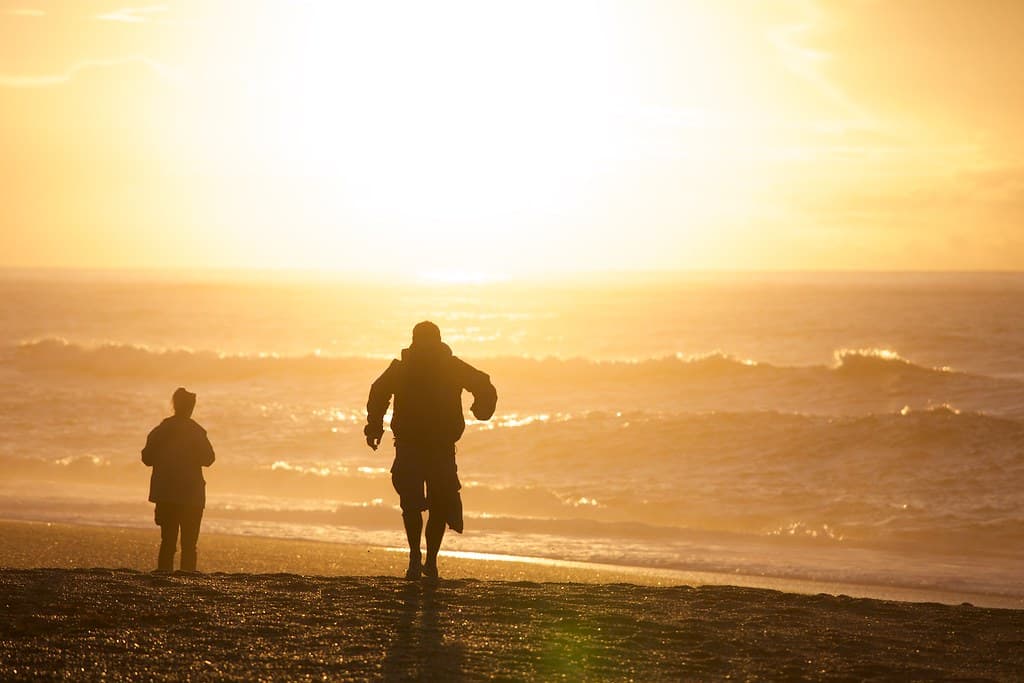
The stairs zigzag down the cliff face, handrails slick with ocean spray even on dry days. You count roughly eighty steps before your boots meet stones the size of plums and cricket balls, grey and charcoal and occasionally streaked with white quartz. There's no sand here—just millions of rocks tumbled smooth by centuries of Tasman violence. When waves withdraw, the stones roll and knock together with a hollow percussion that drowns out conversation. Seaweed drapes across the larger boulders, dark ribbons of bull kelp still attached to holdfasts. The beach curves in a tight crescent, hemmed by cliffs draped in coastal forest—rimu, kamahi, rata. Spray carries fifty meters inland when southwesterlies hit. You'll taste salt on your lips within minutes. The water beyond the shore-break churns bottle-green, opaque with tannins from the rivers that drain these mountains. Swimming isn't advisable; the undertow rivals the rips of the North Island's notorious west coast. Above, you'll hear the occasional car engine or tour bus air brake. Down here, isolated by the cliff's bulk, you exist in a pocket of wilderness that feels miles from the highway. Driftwood logs, bleached silver and smooth as bones, rest against the tideline. You'll pocket a few stones—impossible not to—then climb back toward the viewpoint, lungs working, legs burning, the beach's roar fading behind you.
Places, rentals, tours and events within walking and driving distance of Knights Point Beach.
Photos
Knights Point Beach is not recommended for swimming due to its wild, exposed nature on the West Coast of New Zealand's South Island. The beach experiences powerful surf, strong currents, unpredictable waves, and cold water temperatures year-round. There are no lifeguard patrols or safety facilities. The pebble beach and rocky surroundings create hazardous conditions. The area is best appreciated for its dramatic scenery rather than water activities. If you do approach the water's edge, exercise extreme caution and never turn your back on the ocean, as unexpected waves can occur.
The best time to visit Knights Point Beach is during settled weather with good visibility to fully appreciate the dramatic coastal scenery. Summer months (December to February) generally offer the most stable conditions, though the West Coast is known for unpredictable weather year-round. Early morning or late afternoon provides excellent photography light. Avoid visiting during heavy rain, strong winds, or storms when conditions become dangerous. The Knights Point lookout above the beach is the main attraction and can be visited briefly as part of a scenic drive along the West Coast.
Knights Point Beach is located below the Knights Point Lookout on State Highway 6 between Haast and Fox Glacier on New Zealand's West Coast. The lookout is a well-marked stopping point along this scenic coastal highway, approximately 45 kilometres north of Haast. Parking is available at the lookout area. Access to the beach itself requires carefully descending a steep, potentially slippery track, which may not be suitable for all visitors. Most people view the beach from the lookout viewpoint above. The drive along this highway is spectacular but requires careful attention.
Knights Point Beach is in a remote location with no facilities directly on-site. The nearest accommodation and dining options are in Haast (approximately 45 kilometres south) or Fox Glacier (approximately 90 kilometres north). Both townships offer limited services including motels, lodges, holiday parks, cafes, and small stores. Visitors should plan accordingly, carrying food, water, and emergency supplies when travelling this remote coastal stretch. Mobile phone coverage is unreliable in this area. The Knights Point stop is typically a brief scenic break during longer journeys along the West Coast.
Knights Point Beach offers one of the most spectacular coastal viewpoints on New Zealand's West Coast, combining rugged shoreline, dramatic rock formations, and the Tasman Sea meeting ancient rainforest-clad mountains. The lookout provides panoramic views that are exceptional for photography, particularly the wild, untouched character of this coastline. The area represents the raw beauty of the West Coast's wilderness landscape. While the beach itself is small and not suitable for recreation, the brief stop rewards travellers with memorable scenery. Interpretation panels provide geological and historical context for the area.