Counting the waves…
Counting the waves…
A refined fusion of water purity, environmental stability, and communal vibrancy for Loh Samah Bay.
View MethodologyAnalyzed via live sensors and environmental data.
Wave height, wind, and atmospheric stability.
Live footfall and crowd balance metrics.
Community reviews and curated sentiment.
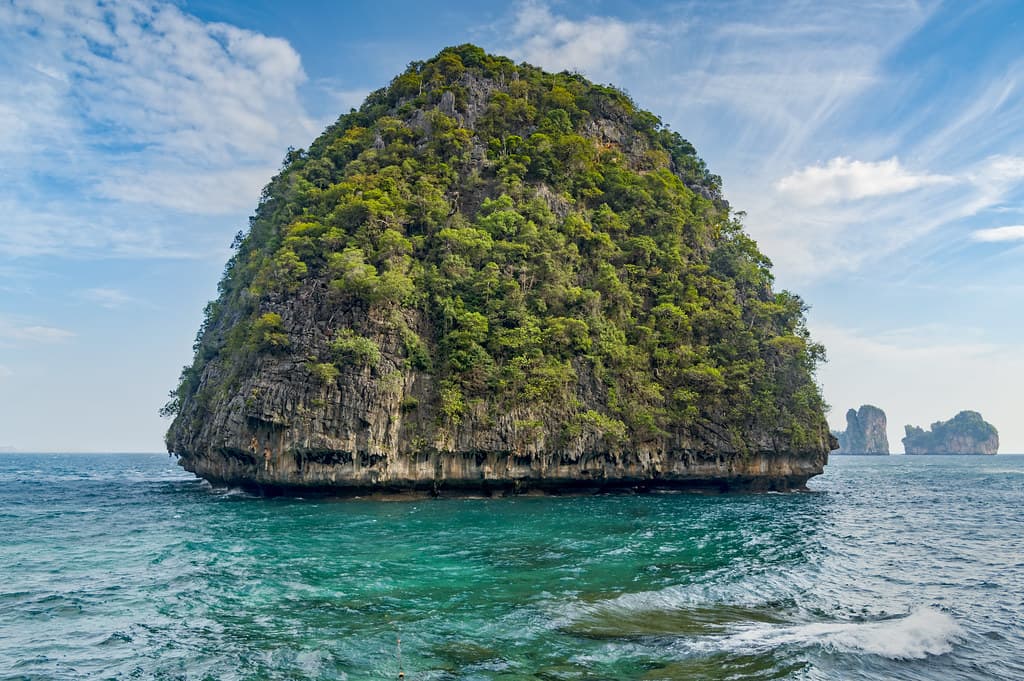
“Your longtail threads through a narrow entrance barely wider than two boats, limestone walls rising sheer on both sides. Inside, the bay opens like a secret: steep cliffs forming a near-circle around water that shifts…”
Limited recent visitor reports — live OBI telemetry is your best guide for current conditions.
You drop into water that's several degrees cooler than the shallows outside—upwelling from the bay's fifty-meter depths bringing nutrients and visibility that stretches twenty meters horizontally. Below your fins, the bottom drops away in terraces: a sandy shelf at three meters giving way to coral bommies at ten, then a vertical wall that plunges into darkness. Sergeant majors and damselfish swirl around the bommies, their colors saturated in the filtered light.
The bay's walls lean inward, creating a sense of enclosure that's amplified by the narrow entrance behind you. Overhead, vegetation clings to impossible angles—sea hibiscus and pandanus whose roots find purchase in limestone cracks. At the inlet's far end, a small beach of coarse sand wedges between cliff faces, accessible only at low tide when the water retreats enough to expose the walking margin. Most visitors never reach it, preferring to snorkel the coral terraces where hawksbill turtles occasionally glide past, oblivious to the humans hanging at the surface.
 Credit: Unsplash
aerial view photography of shore between cliffs during daytime
 Credit: Unsplash
A cloudy sky over a sandy beach with rolling hills
Terraced corals host wrasse
Fifty meters, cool upwelling
Hawksbills and reef structure
Prime Visitation
Best Weather
Where it is
Loh Samah Bay
Phi Phi Leh, Krabi, Thailand
7.677300°, 98.746800°
Weather
Loading…
Swell
—
Temp
Warm · Restorative
UV Index
Moderate
Wind
—
Tidal State
Last known
Max Sunlight
—
Ideal Shade
—
Jan - Dec (Peak)
May - Nov (Off-season)
Historical data suggests peak visibility and stable sea temperatures occur during the prime visitation window.
Near Loh Samah Bay
Explore dining, stays, nightlife, and activities near Loh Samah Bay in Phi Phi Leh, Thailand. Every listing below is a real place linked to this beach — open a card for reviews, maps, and booking options.
Food, cafés, and dining close to Loh Samah Bay — curated from places linked to this beach.
Activities, tours, and attractions near Loh Samah Bay.
Select a category to load nearby places.
Unlock restaurants, luxury stays and curated maritime experiences within 2km
Loh Samah Bay offers generally safe conditions for swimming and snorkeling, particularly during the dry season (November-April) when seas are calm. The sheltered cove provides protection from waves, creating clear, tranquil waters ideal for viewing marine life. However, be aware of boat traffic from tour operators entering the bay. Current regulations may limit or prohibit swimming to protect the marine ecosystem, as Phi Phi Leh is part of a national park with conservation measures. Always check current access rules, wear appropriate flotation if needed, and be mindful of coral—avoid touching or standing on it.
The best time to visit Loh Samah Bay is during Thailand's dry season from November to April, when weather is optimal with calm seas, clear skies, and excellent underwater visibility for snorkeling. This period offers the most reliable boat access and comfortable conditions. However, these months also bring more tourists. For a balance of good weather and fewer crowds, consider visiting in November or April. The bay may be inaccessible during monsoon season (May-October) due to rough seas. Arriving early morning (before 10am) helps avoid peak tour boat crowds.
Loh Samah Bay is accessible only by boat, as Phi Phi Leh is an uninhabited island. The most common approach is joining organized boat tours from Phi Phi Don, Phuket, or Krabi, which typically include Loh Samah Bay alongside other Phi Phi islands attractions like Maya Bay. Tours depart daily during high season, taking 45 minutes to 2 hours depending on departure point. You can also hire private longtail boats or speedboats from Phi Phi Don for more flexibility. All visitors must pay Hat Noppharat Thara-Mu Ko Phi Phi National Park entrance fees.
Loh Samah Bay has absolutely no facilities, accommodation, or restaurants, as Phi Phi Leh island is uninhabited and protected as part of a national park. All visits are day trips only, typically lasting 30-60 minutes as part of broader island-hopping tours. Visitors must bring their own water, snacks, and supplies, and should take all trash with them. All accommodation and dining options are located on neighboring Phi Phi Don island (Tonsai Village area) or on the mainland in Phuket, Krabi, or Ao Nang, where tour operators are based.
Loh Samah Bay is renowned for its excellent snorkeling opportunities in a sheltered, scenic setting. The cove's calm, clear waters provide visibility to observe diverse marine life including tropical fish, coral formations, and occasionally sea turtles. The bay's protected position creates tranquil conditions ideal for beginner and intermediate snorkelers. Its dramatic limestone cliffs rising from turquoise waters create a stunning backdrop for the underwater experience. However, conservation efforts may periodically restrict access to protect the delicate marine ecosystem, so the bay's special appeal lies in both its natural beauty and ecological importance.
Photos