Counting the waves…
Counting the waves…
A refined fusion of water purity, environmental stability, and communal vibrancy for Gold Harbour Beach.
View MethodologyAnalyzed via live sensors and environmental data.
Wave height, wind, and atmospheric stability.
Live footfall and crowd balance metrics.
Community reviews and curated sentiment.
“You step from the Zodiac onto smooth, glacier-worn stones, and the chorus hits you—barking fur seals, the trumpet calls of kings, the crash of ice breaking from the Bertrab Glacier. Gold Harbour sits in an amphitheater…”
Limited recent visitor reports — live OBI telemetry is your best guide for current conditions.
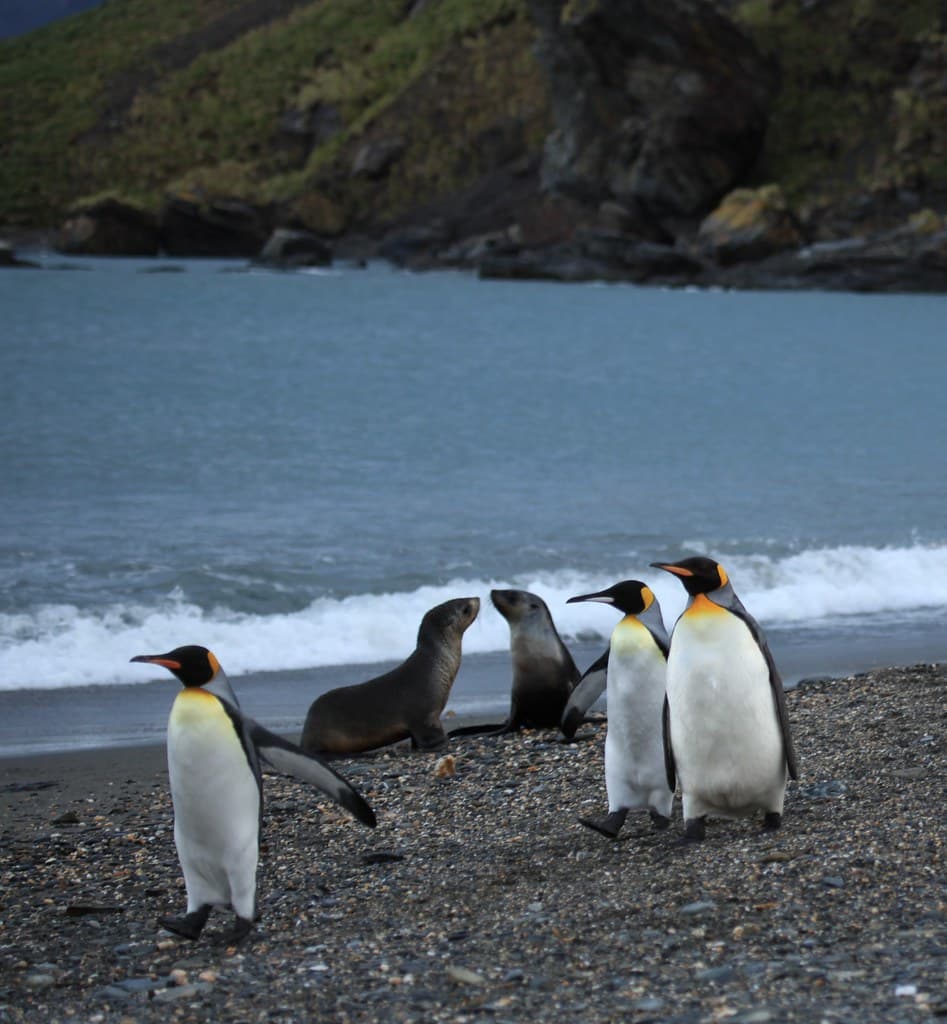
Gold Harbour earns its name not from sand but from the tawny light that washes over its gravel at dawn, gilding the rookery of king penguins that stretches inland toward the tussock grass. You navigate carefully among elephant seals sprawled like boulders, their breath steaming in the Antarctic air, while chicks in brown down huddle in crèches overseen by indifferent adults. The beach curves beneath cliffs streaked with guano and lichen, and behind it all the Bertrab Glacier hangs in blue-white folds, groaning as chunks calve into the bay.
This is expedition cruising at its rawest: no pier, no path, just a wet landing onto stones that shift under your boots. The wind carries brine and the ammoniac tang of the colony. Fur seals patrol the wrack line, and you give them wide berth—this is their nursery, and they defend it. Photographers crouch low, framing kings against the ice; hikers who've earned permission scramble the ridges for views over Bertrab Valley and the peaks that ring this pocket of coast.
 Credit: Unsplash
a sandy beach with a body of water in the background
 Credit: Unsplash
sea waves crashing on shore during daytime
Shoot chicks in brown plumage
Bertrab Valley overlook with permit
Blue ice shearing from face
Prime Visitation
Best Weather | Less Crowds
Where it is
Gold Harbour Beach
Grytviken, Antártida e Islas del Atlántico Sur, Argentina
-54.626800°, -35.930600°
Weather
Loading…
Swell
—
Temp
Warm · Restorative
UV Index
Moderate
Wind
—
Tidal State
Last known
Max Sunlight
—
Ideal Shade
—
Jan - Dec (Peak)
Mar - Nov (Off-season)
Best Weather | Less Crowds
Select a category to load nearby places.
Unlock restaurants, luxury stays and curated maritime experiences within 2km
Gold Harbour Beach requires strict adherence to wildlife safety protocols. Visitors must maintain minimum distances: 5 meters from penguins and seals, further from fur seals which can be aggressive, especially during breeding season. Elephant seals, despite appearing docile, can move surprisingly fast and may react defensively. Never walk between animals and the water, blocking their escape route. Tour leaders enforce IAATO guidelines to protect both wildlife and visitors. Weather hazards include sudden storms, cold temperatures, and strong katabatic winds descending from glaciers. Landing conditions change rapidly, and Zodiac landings can be challenging in swell.
The optimal visiting window is during the austral summer, November through March, when expedition ships can access South Georgia and wildlife activity is highest. December and January offer peak king penguin chick viewing, with fluffy brown chicks present. February and March feature elephant seal breeding activity and moulting penguins. November sees penguins courting and nesting. Weather is most stable during these months, though conditions remain unpredictable and cold. Most visitors arrive on expedition cruises during this narrow season, as winter ice and extreme weather make access impossible outside these months.
Gold Harbour is accessible only by expedition cruise ship, as South Georgia has no airports or regular ferry services. Most voyages depart from Ushuaia, Argentina, requiring a 2-day crossing of the Drake Passage and Scotia Sea. Ships anchor offshore, and passengers reach the beach via Zodiac landings, weather permitting. The journey typically takes 6-10 days round-trip including multiple South Georgia landings. Landings are never guaranteed, as weather, sea conditions, and wildlife presence determine feasibility. All visits require permits and must follow strict environmental protocols administered by the Government of South Georgia and South Sandwich Islands.
Gold Harbour Beach has absolutely no facilities, accommodation, or infrastructure of any kind. It is a completely wild, uninhabited location with no buildings, trails, or services. All visitors stay aboard expedition ships anchored offshore, which provide all meals, accommodation, and amenities. Landings are typically 2-3 hours maximum, with no toilets or shelter ashore. Visitors must be self-sufficient and properly equipped with polar clothing. The nearest settlement is the small research station and museum at Grytviken, which itself offers no tourist accommodation. This pristine wilderness setting is part of Gold Harbour's appeal.
Gold Harbour offers extraordinary photographic opportunities combining dramatic glacial backdrop, towering coastal cliffs, and abundant wildlife in one location. The hanging glacier provides spectacular scenery behind king penguin colonies numbering tens of thousands. Elephant seals haul out on the dark pebble beach, creating scale and wildlife diversity. The setting allows compositions featuring mountains, glaciers, ocean, and wildlife together. Light conditions during austral summer provide long hours for photography. The beach's amphitheatre-like geography frames subjects beautifully. Weather creates dramatic, ever-changing conditions with mist, clouds, and occasional sunshine creating Instagram-worthy moments throughout visits.
Photos