Counting the waves…
Counting the waves…

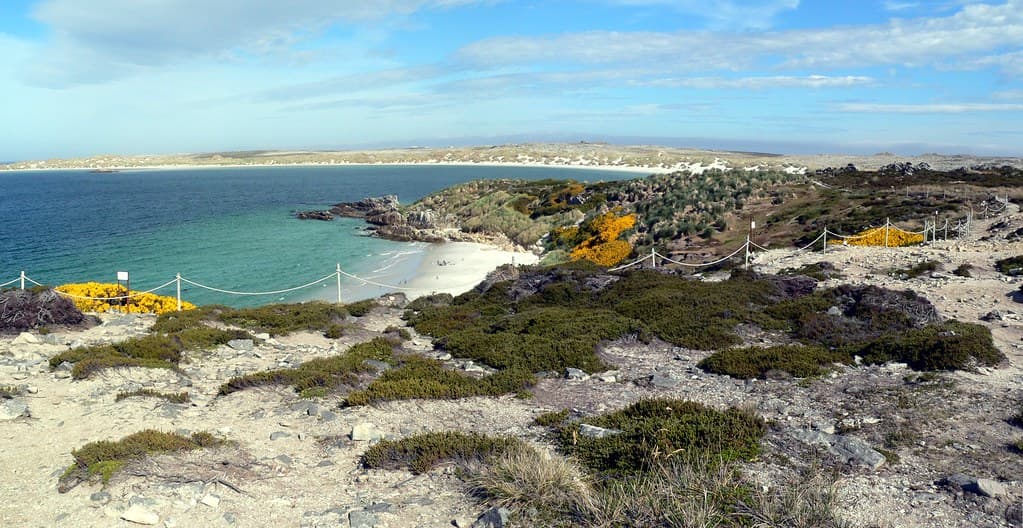
The walk to Gypsy Cove follows a boardwalk edged with faded red-and-white minefield warning signs, relics of the 1982 conflict that have become part of the landscape's strange poetry. Magellanic penguins ignore these human boundaries entirely, crossing the path with the unhurried confidence of longtime residents. Their burrows honeycomb the hillsides above the beach, and during breeding season the air fills with their donkey-like calls and the sharp scent of guano mixed with salt spray. The beach itself curves in a shallow arc, its sand darkened by volcanic minerals and littered with bull kelp that snaps and pops underfoot. Southern sea lions haul out on offshore rocks, their barks carrying across the water when the wind shifts. You'll want layers—the Falklands wind is relentless, even in summer, driving low clouds across a sky that can turn from pewter to brilliant blue in minutes. The water temperature hovers around 9°C year-round, numbing but alive with upwellings that feed the entire food chain. Most visitors arrive mid-morning when the penguins are most active, marching between their nests and the sea in single-file processions that seem almost ceremonial. The beach faces northeast, sheltered enough that you can sit among the tussac clumps and watch the colony's daily rhythms unfold—preening, squabbling, the occasional belly-slide down a muddy bank toward the surf.
Places, rentals, tours and events within walking and driving distance of Gypsy Cove.
Photos
Swimming at Gypsy Cove is not advisable due to frigid water temperatures and strong ocean currents. The beach is primarily a wildlife viewing and walking destination rather than a swimming spot. Additionally, parts of the surrounding area have historical landmine warnings from the 1982 conflict, though marked paths are completely safe to use. Always stay on designated trails and boardwalks. The focus here is coastal scenery and penguin observation, not water recreation.
Visit Gypsy Cove between November and March during the Falklands summer for the best weather and peak penguin activity. December through February offers optimal conditions with milder temperatures, longer daylight, and active penguin colonies with chicks. The shoulder months of November and March provide fewer visitors while still offering good wildlife viewing. Weather can change rapidly regardless of season, so prepare for wind and pack layered clothing even during summer months.
Gypsy Cove is located about 3 kilometers from Stanley, making it one of the most accessible wildlife sites in the Falklands. You can reach it by rental car, taxi, bicycle, or on foot via a coastal road. The drive takes approximately 10 minutes, while walking takes 45-60 minutes. Many visitors join organized tours from Stanley that include transportation and guided wildlife interpretation. A well-maintained boardwalk leads from the parking area to the penguin viewing areas.
Gypsy Cove has no facilities, accommodation, or food services on-site. It's a protected natural area designed for day visits and wildlife observation. Visitors should bring their own refreshments, snacks, and water. All accommodation and dining options are located in nearby Stanley, approximately 3 kilometers away, where you'll find hotels, guesthouses, pubs, and restaurants. Most people visit Gypsy Cove as a half-day excursion from Stanley-based accommodation.
Gypsy Cove is famous for its accessible Magellanic penguin colony, allowing visitors close-up views of these charismatic seabirds in their natural habitat. The protected cove features a purpose-built boardwalk that brings you within meters of penguin burrows without disturbing the birds. During breeding season, you can observe nesting behaviors, chicks, and active colonies. The dramatic coastal scenery, combined with interpretive information and easy access from Stanley, makes it one of the Falklands' premier wildlife-watching destinations.