Counting the waves…
Counting the waves…
A refined fusion of water purity, environmental stability, and communal vibrancy for Playa Canal Beagle Lapataia.
View MethodologyAnalyzed via live sensors and environmental data.
Wave height, wind, and atmospheric stability.
Live footfall and crowd balance metrics.
Community reviews and curated sentiment.
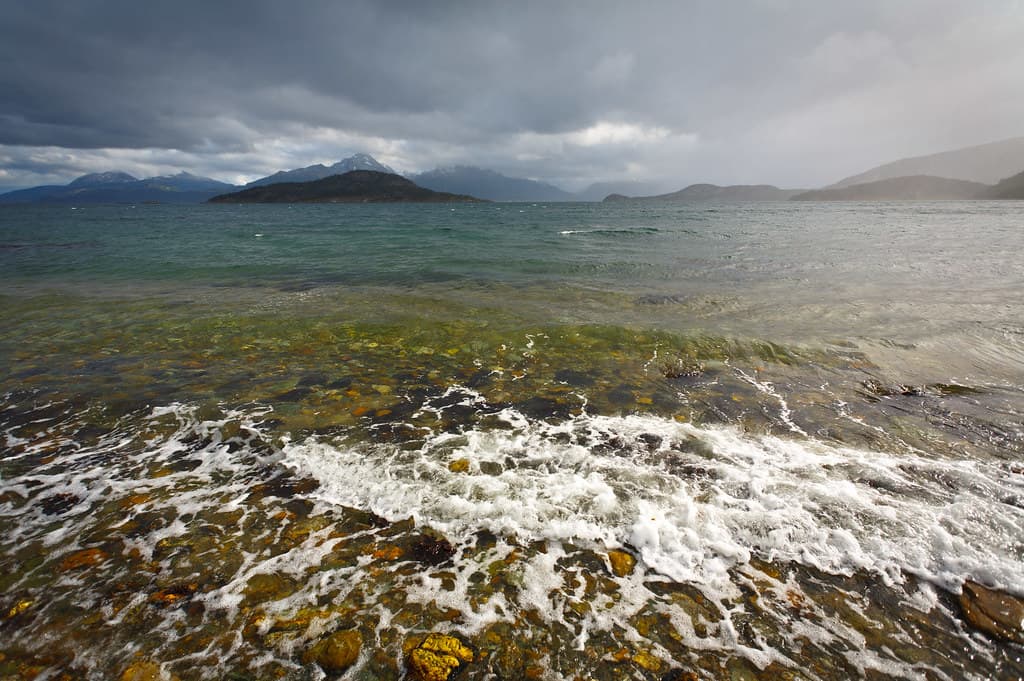
“You stand on smooth stones worn by channel currents, watching cormorants skim across water the color of steel. Behind you, twisted lenga trees frame peaks that hold snow even in summer.”
Limited recent visitor reports — live OBI telemetry is your best guide for current conditions.
The beach announces itself with the rattle of wave-smoothed pebbles beneath your feet—oval stones in charcoal, rust, and bone that shift and click with each footfall. Cold water from the Beagle Channel laps at rounded rocks, and the air tastes of salt mixed with the green dampness of southern beech forest. You're standing at the collision point of mountain, channel, and woodland, where the Andes finally surrender to the sea.
Cormorants and gulls patrol the shoreline while oystercatchers probe between stones. The mountains across the channel belong to Chile, their ridges sharp against whatever sky Patagonia offers today—pewter clouds, rare blue, or the flat white that precedes snow. Wind is constant here, carrying the smell of kelp and the faint diesel scent from distant fishing boats.
 Credit: Unsplash
brown wooden boat on sea dock during daytime
 Credit: Unsplash
a couple of boats floating on top of a large body of water
Wind-blown paths through lenga forest
Capture Chilean peaks across water
Hunt wave-polished Andean stones
Prime Visitation
Anytime | Less Crowds
Where it is
Playa Canal Beagle Lapataia
Ushuaia, Tierra del Fuego, Argentina
-54.855800°, -68.553600°
Weather
Loading…
Swell
—
Temp
Warm · Restorative
UV Index
Moderate
Wind
—
Tidal State
Last known
Max Sunlight
—
Ideal Shade
—
Jan - Dec (Peak)
Mar - Nov (Off-season)
Anytime | Less Crowds
Select a category to load nearby places.
Unlock restaurants, luxury stays and curated maritime experiences within 2km
Swimming is generally not recommended at this beach. The Beagle Channel's water temperatures remain extremely cold year-round, typically between 4-9°C (39-48°F), making swimming dangerous without proper cold-water gear. The pebble shore and occasional strong currents add additional risks. Most visitors come for scenic walks, photography, and wildlife viewing rather than water activities. Always stay aware of weather conditions, as Patagonian weather can change rapidly. If you do wade, limit exposure and never go alone.
The beach is accessible year-round, though each season offers different experiences. Summer (December-February) provides the longest daylight hours and mildest temperatures (5-15°C), ideal for extended exploration. Autumn (March-May) delivers stunning foliage colors in surrounding forests. Winter (June-August) brings snow-covered landscapes but shorter days and harsher conditions. Spring (September-November) offers emerging wildlife activity. Regardless of season, expect unpredictable weather and dress in layers. The beach sees fewer crowds than other Ushuaia attractions throughout the year.
The beach is located within Tierra del Fuego National Park, approximately 12 kilometers west of Ushuaia. To reach it, enter the park via Route 3 (entrance fee required). You can drive a private or rental vehicle, take organized tours from Ushuaia, or use the seasonal tourist train (Tren del Fin del Mundo) which stops within the park. From parking areas, short walking trails lead to the beach. Public bus service to the park operates during peak season. The road is paved and generally accessible year-round, though winter may require caution.
There are no restaurants or accommodations directly at the beach, as it's within a protected national park. The park has basic visitor facilities including restrooms and a small café near the entrance, but food options are limited. Visitors should bring their own food, water, and snacks. All lodging, restaurants, and full services are located in Ushuaia, about 20-30 minutes away by car. The city offers diverse accommodation options from hostels to luxury hotels and numerous restaurants. Plan to make this a day trip from Ushuaia with packed provisions.
This beach offers an exceptional combination of dramatic Patagonian scenery where mountains, sub-Antarctic forest, and the historic Beagle Channel converge. The remote-feeling location provides a sense of wilderness despite being relatively accessible. The beach serves as an excellent viewpoint for spotting seabirds, occasional marine mammals, and the mountainous Chilean coast across the channel. The surrounding national park's pristine ecosystem and the symbolic significance of being near the 'end of the world' on Route 3 make it particularly special. The dramatic light and ever-changing weather create unique photographic opportunities.
Photos