Counting the waves…
Counting the waves…

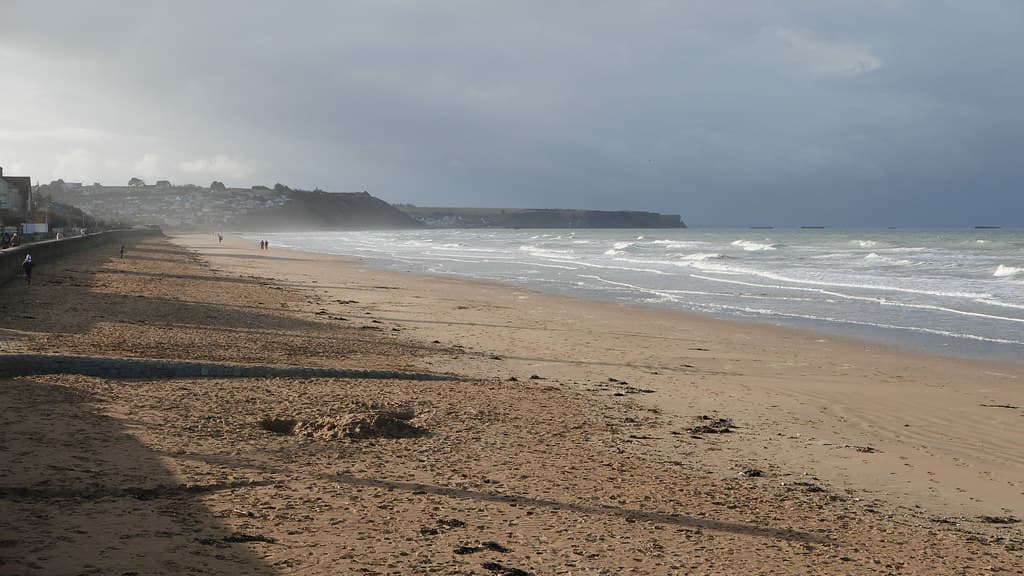
The massive concrete caissons loom in the shallows like beached whales, oxidized orange and barnacle-crusted, their geometry still sharp after eight decades. You step onto the mix of sand and pebbles at Arromanches, and the remnants of Operation Overlord's artificial harbor stretch before you—Phoenix breakwaters listing at odd angles, pierced by circular apertures now colonized by mussels and seaweed. At low tide, you can walk among them, your boots crunching on the same beach where 500,000 troops and vehicles poured into France. But this isn't a somber monument frozen in time. Families spread picnics on the seawall steps, teenagers dare each other to swim out to the nearest caisson, and the scent of moules-frites drifts from the beachfront cafés lining Rue du 6 Juin. The Musée du Débarquement sits above the sand in a bunker-style building, its terrasse offering a panoramic view that transforms the rusty platforms into context. You understand viscerally what historians can only describe. The Norman light changes constantly—steel-gray squalls blow through in minutes, replaced by shafts of gold that turn the English Channel peacock-blue. At sunset, the caissons become silhouettes, and you might see an elderly veteran pause at the railing, or a young couple photographing what their grandparents liberated. The beach holds both stories without contradiction.
Places, rentals, tours and events within walking and driving distance of Plage d'Arromanches-les-Bains.
Photos
Swimming is generally possible at Arromanches, though conditions vary with tides and weather. The beach has a gentle slope but currents can strengthen during high tide. There are no lifeguards year-round, so swimming is at your own risk. Many visitors wade rather than swim due to cooler English Channel temperatures. The beach is more popular for walking and exploring the historic Mulberry Harbour remains than for swimming. Always check tide times and weather forecasts before entering the water, and supervise children closely near the shoreline.
Arromanches beach is accessible year-round, with each season offering different appeal. Summer (June-August) brings warmer weather and longer days, ideal for families, though it's busiest then. Spring and autumn offer milder temperatures, fewer crowds, and excellent conditions for photographing the D-Day landing remnants. Winter provides dramatic coastal scenery and stormy skies. For D-Day history enthusiasts, visiting around June 6th offers special commemorations. Low tide is best for exploring the Mulberry Harbour pontoons up close, regardless of season.
Arromanches offers several parking options near the beach. The main public car park is located on Boulevard Gilbert Longuet, just steps from the seafront and D-Day museum. Parking is paid during peak season (typically Easter through September) and costs approximately €3-5 for several hours. Additional street parking is available throughout the small town. During summer and D-Day anniversary periods, parking fills quickly by mid-morning. Arriving early or visiting off-season ensures easier access. The compact town makes everything walkable once parked.
Arromanches-les-Bains offers numerous dining and lodging options within walking distance of the beach. Seafront restaurants serve fresh seafood, crêpes, and traditional Norman cuisine, many with views of the Mulberry Harbour remains. The town has several hotels ranging from budget to mid-range, plus vacation rentals and B&Bs. For more extensive options, Bayeux is 10km inland. Popular beachfront spots include café-restaurants along Rue du Maréchal Joffre. Booking accommodation ahead is essential during summer and early June when D-Day commemorations draw large crowds.
Yes, substantial remains of the artificial Mulberry B harbour are still visible at Arromanches beach. Large concrete caissons and pontoon sections sit in the water offshore and can be viewed from the beach year-round. At low tide, you can walk closer to some structures, though they remain offshore. The remnants are particularly atmospheric at sunset. The Arromanches 360 Circular Cinema and D-Day Museum provide historical context. These are among the most significant and accessible D-Day landing infrastructure remains along the Normandy coast, making Arromanches essential for history enthusiasts.