Counting the waves…
Counting the waves…
A refined fusion of water purity, environmental stability, and communal vibrancy for Plage de Ficajola.
View MethodologyAnalyzed via live sensors and environmental data.
Wave height, wind, and atmospheric stability.
Live footfall and crowd balance metrics.
Community reviews and curated sentiment.
“The boat captains from Porto point it out on their Scandola tours—a tiny notch in the cliffs where pebbles glow copper in afternoon light. Most passengers just photograph it. A few return with kayaks or hiking boots to…”
Limited recent visitor reports — live OBI telemetry is your best guide for current conditions.
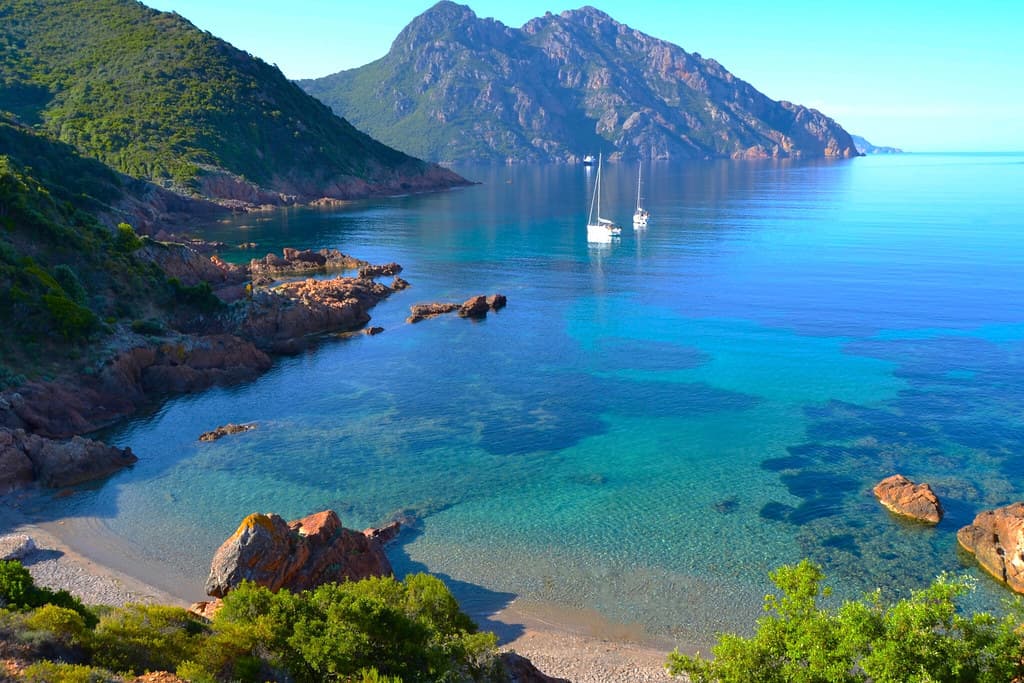
Plage de Ficajola reveals itself only from the water or the rocky trail that switchbacks down from the coastal maquis above Osani. The cove is narrow, perhaps thirty meters of smooth stones ranging from terracotta to rust, sheltered by cliffs of volcanic rock that catch the light in bands of orange and charcoal. At your back, the cliff face rises steep and striated; ahead, the sea runs cobalt deep, the kind of blue that suggests serious depth just beyond the shore.
The pebbles shift underfoot with each wave, a rhythmic clatter that echoes off the rock walls. Snorkeling here is like swimming the edge of a submerged caldera—the bottom drops quickly, and the water stays cool and gin-clear even in high summer. You'll spot grouper hovering in the shadows where boulders pile up underwater, and damselfish darting through curtains of sunlight.
 Credit: Unsplash
a view of a beach from a hill overlooking the ocean
 Credit: Unsplash
A view of a beach and ocean from a hill
Grouper and damselfish below
Coastal exploration by sea
Scramble trail through maquis
Prime Visitation
Best Weather|Less Crowds
Where it is
Plage de Ficajola
Osani, Corse-du-Sud, France
42.326700°, 8.626700°
Weather
Loading…
Swell
—
Temp
Warm · Restorative
UV Index
Moderate
Wind
—
Tidal State
Last known
Max Sunlight
—
Ideal Shade
—
May - Sep (Peak)
Jan - Dec (Off-season)
Best Weather|Less Crowds
Select a category to load nearby places.
Unlock restaurants, luxury stays and curated maritime experiences within 2km
Swimming conditions vary depending on weather and sea state. This cove typically offers protection from waves, making it safer than exposed beaches, but there are no lifeguards or facilities. The clear waters and rocky seabed are ideal for snorkeling when calm. Be cautious of boat traffic, as this beach lies on the approach to Scandola. Always assess current conditions before entering the water and never swim alone. Strong swimmers will find it generally suitable in good weather.
Late spring (May-June) and early autumn (September-October) offer the best combination of good weather and fewer visitors. Summer months bring more boat traffic along the Scandola route. Weather is generally most stable from June through September, with warmest water temperatures in July and August. Early morning visits help avoid crowds and provide calmer seas. Check marine forecasts if arriving by boat, as conditions can change rapidly along this exposed coastline.
Boat access is the primary and most practical way to reach this cove, either by private vessel, kayak, or boat tour departing from Porto or Galéria. The beach lies along popular Scandola Nature Reserve tour routes. While hiking access may be theoretically possible, the terrain is extremely rugged and not recommended without local expertise. Many visitors combine this stop with broader Scandola exploration. Tours typically don't land but may pause for swimming and snorkeling nearby.
This is a completely wild, undeveloped beach with absolutely no facilities—no toilets, showers, beach bars, or equipment rentals. Bring everything you need, including drinking water, food, sun protection, and snorkeling gear. The nearest services are in Osani village or Galéria, both requiring boat or road travel. Pack out all waste to preserve the pristine environment. The isolation is part of the appeal for visitors seeking natural, unspoiled coastal scenery away from developed beaches.
Its location on the Scandola-Porto approach places it within one of Corsica's most spectacular natural landscapes, near the UNESCO-protected Scandola Nature Reserve. The strong natural discovery value comes from its wild, undeveloped character and the dramatic coastal geology surrounding it. Snorkelers can explore rich marine life in exceptionally clear waters. The remoteness ensures an authentic wilderness experience. The cove exemplifies Corsica's rugged western coastline, with striking rock formations and pristine conditions rarely found at more accessible beaches.
Photos