Counting the waves…
Counting the waves…
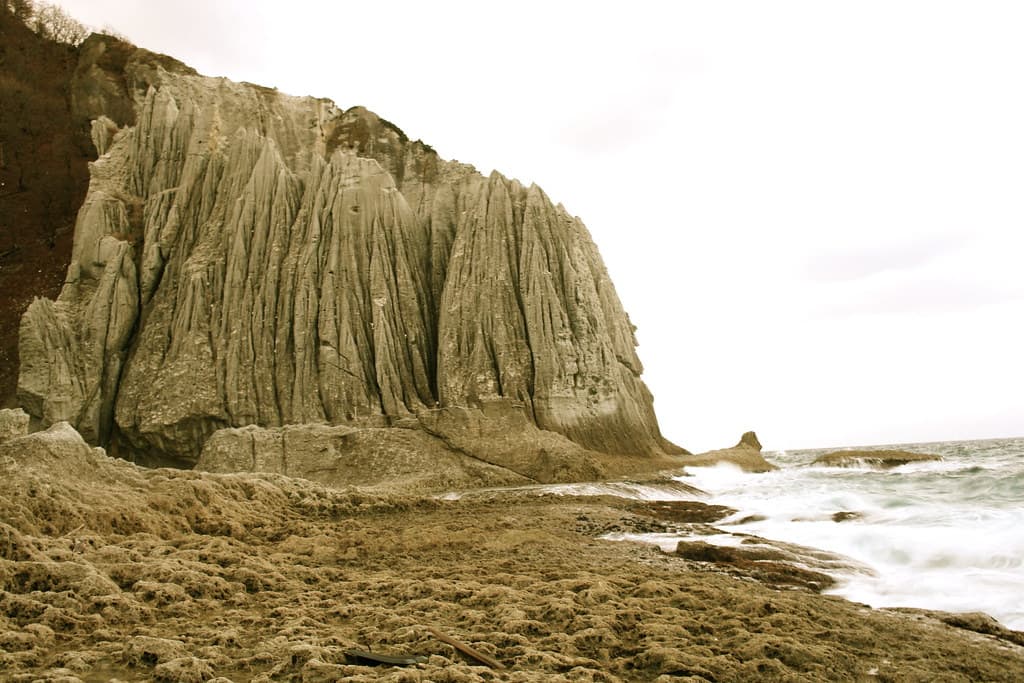
The drive north from Mutsu city traces a coastline that grows wilder with every kilometer, until you reach Sai and the turnoff to Isoya Beach. Here, stratified rock formations jut into the Tsugaru Strait like the ribs of some ancient vessel, their angles sharpened by millennia of northern swells. Tidal pools collect in the volcanic hollows, and when fog rolls in from Hokkaido—visible across the water on clear days—the beach takes on the quality of a woodblock print come to life. You'll scramble over boulders slick with kelp, feeling the spray on your face as waves detonate against offshore stacks. In summer, local families arrive with coolers and fishing rods, settling into the rhythm of a place that doesn't perform for visitors. The few who make the journey in autumn witness something rarer: the clash of season-change light against dark stone, when the angle of sun renders every surface molten. This isn't a beach for spreading towels or losing afternoons to easy swims. It asks you to engage with its topography, to read the tide charts, to accept that beauty here comes with barnacle-scraped shins and salt-stiffened hair. The reward is a coastline still governed by weather and geology rather than expectation.
Places, rentals, tours and events within walking and driving distance of Isoya Beach.
Photos
Isoya Beach features a dramatic rocky coastline that makes it more suitable for scenic viewing than swimming. The rocky terrain and coastal conditions can create unpredictable currents and wave patterns. If you do choose to enter the water, exercise extreme caution, wear appropriate footwear to protect against sharp rocks, and stay close to shore. The beach is primarily visited for its photogenic landscapes rather than swimming activities. Always check local weather conditions before visiting and avoid the water during rough seas or inclement weather.
Isoya Beach can be visited year-round, with each season offering distinct experiences. Summer (June-August) provides the warmest weather and calmer seas, ideal for exploring the rocky coastline. Spring and autumn offer mild temperatures and fewer crowds, perfect for photography and peaceful walks. Winter visits showcase dramatic wave action against the rocks, though weather can be harsh with strong winds and snow. For the best combination of pleasant weather and scenic beauty, consider visiting during late spring (May) or early autumn (September-October) when conditions are generally favorable.
Isoya Beach is located in Sai, Aomori Prefecture, and is best accessed by car as public transportation options are limited in this rural coastal area. From Aomori city, drive along Route 280 heading toward the Tsugaru Peninsula. The beach is relatively remote and less developed than major tourist beaches. Parking availability may be limited and informal, typical of hidden coastal spots in rural Japan. Using GPS navigation with Japanese coordinates is recommended. Consider renting a car from Aomori city for the most convenient access to this off-the-beaten-path destination.
As a hidden beach in rural Aomori, Isoya Beach has minimal on-site facilities or nearby amenities. Don't expect beach services, restrooms, or food vendors directly at the beach. The small fishing community of Sai may have basic local shops or small eateries, but options are limited. For reliable dining and lodging, plan to stay in larger nearby towns or Aomori city, located approximately 30-50 kilometers away. Bring your own food, water, and supplies when visiting. Consider this a day trip destination rather than expecting resort-style facilities or beachside restaurants.
Isoya Beach's dramatic rocky coastline offers exceptional photography opportunities with its rugged natural formations and relatively untouched scenery. The rocky outcrops create striking compositions, especially during sunrise, sunset, or when waves crash against the stones. Being a hidden beach, you'll likely find solitude for uninterrupted shots without crowds. The changing seasons dramatically alter the landscape's character—from summer's deep blues to winter's powerful storm waves. The remote location also means minimal light pollution, potentially offering clear night sky photography. Bring a sturdy tripod and weather protection for your equipment.