Counting the waves…
Counting the waves…
A refined fusion of water purity, environmental stability, and communal vibrancy for Totaranui Beach.
View MethodologyAnalyzed via live sensors and environmental data.
Wave height, wind, and atmospheric stability.
Live footfall and crowd balance metrics.
Community reviews and curated sentiment.
“You reach this beach either by water taxi or a full day's hike, and the effort filters out the day-trippers. What remains is a proper settlement of tents and trampers, a Department of Conservation campground under…”
Limited recent visitor reports — live OBI telemetry is your best guide for current conditions.
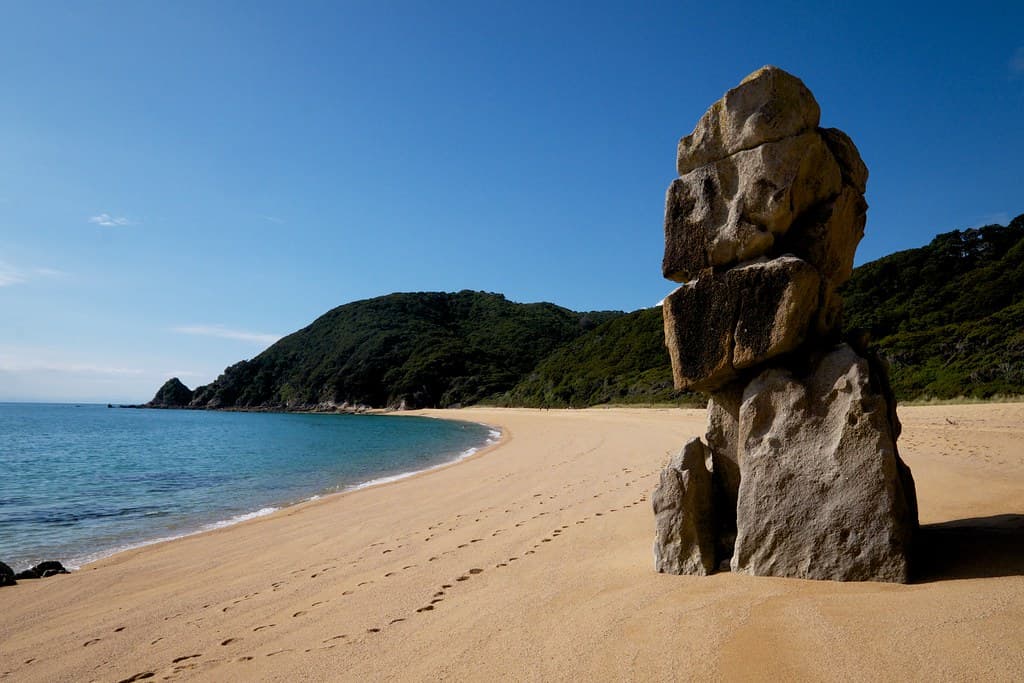
Totaranui sits at the end of the road—literally. Beyond here, Abel Tasman National Park continues only on foot or by boat. The beach arcs across the entire bay, backed by Department of Conservation land where kanuka and rimu lean in close enough that morning dew drips onto tent flies. You hear bellbirds before you're fully awake, their notes cutting through the sound of small waves on sand. The campground sprawls behind the beach, organized into loops and sites, perpetually full in January but surprisingly quiet by March.
The beach itself runs pale gold, firm enough for barefoot walks at any tide. At the southern end, a lagoon forms where a stream meets the sea—warm, shallow, perfect for children who aren't confident in the waves yet. The water beyond is that particular Abel Tasman shade: green-blue in the shallows, deepening to teal where the bay drops off. You'll see kayakers threading between anchored boats, and water taxis making their runs to drop and collect trampers tackling the coastal track in sections.
 Credit: Unsplash
aerial photography of lake during daytime
 Credit: Unsplash
people on beach during daytime
Warm creek mouth for wading
Launch directly from the beach
Northern Abel Tasman trailhead
Prime Visitation
Best Weather|Budget Travel
Where it is
Totaranui Beach
Abel Tasman National Park, Tasman, New Zealand
-40.819900°, 173.003900°
Weather
Loading…
Swell
—
Temp
Warm · Restorative
UV Index
Moderate
Wind
—
Tidal State
Last known
Max Sunlight
—
Ideal Shade
—
Jan - Dec (Peak)
Mar - Nov (Off-season)
Best Weather|Budget Travel
Select a category to load nearby places.
Unlock restaurants, luxury stays and curated maritime experiences within 2km
Totaranui Beach offers generally safe swimming conditions with its gently shelving sandy bottom and sheltered location. The beach faces north within Abel Tasman National Park, protected from strong southerly swells. Waves are typically small to moderate, suitable for families and less confident swimmers. No lifeguard service operates here, so swimmers should exercise personal judgment and supervise children closely. The long beach allows plenty of space to find calm spots. Occasional rips can form during certain tide and swell combinations, so stay aware of conditions and swim near others when possible.
To avoid crowds at Totaranui, visit outside the peak summer holiday period of late December through January. The shoulder months of November, February, and March offer pleasant weather with significantly fewer visitors. Weekdays are quieter than weekends year-round. The campground has limited spaces that book out months in advance for peak season, so accommodation scarcity naturally limits summer crowds for overnight stays. Day visitors arriving by water taxi or walking the Coast Track still come year-round, but numbers drop substantially after January. Early mornings always offer more solitude regardless of season.
Totaranui Beach can be reached by road, water taxi, or hiking. By car, drive approximately 35km from Takaka via Pohara on a partly unsealed road—allow one hour. The road is suitable for regular vehicles but becomes narrow and winding. Water taxis operate from Kaiteriteri and Marahau, offering scenic transfers directly to the beach. Hikers on the Abel Tasman Coast Track can walk from either direction—it's approximately 12km from Wainui or 20km from Marahau. During summer, the road may close to day visitors when the campground reaches capacity, making water access more reliable.
The Department of Conservation operates a large campground at Totaranui with over 800 spaces across campsites and basic cabins. Facilities include toilets, cold showers, and water taps, but no powered sites or shops. Bookings are essential and open months in advance, filling quickly for summer. A nearby Lodge offers more comfortable accommodation with meals available. Day visitors have access to toilets and picnic areas. The nearest supplies and restaurants are in Takaka or Pohara, roughly 35km away. Visitors should arrive fully equipped, bringing all food, camping gear, and supplies needed for their stay.
Totaranui serves as the northern gateway and largest facility hub in Abel Tasman National Park. The extensive campground accommodates hundreds of visitors, making it the park's largest overnight destination. Its road access combined with water taxi services makes it a key entry/exit point for Coast Track hikers. The long, wide beach provides ample space for swimming, kayaking, and beach activities. Several walking tracks radiate from Totaranui, including routes to Separation Point and Whariwharangi. This combination of accessibility, facilities, beautiful beach, and track connections establishes Totaranui as the northern anchor for park exploration.
Photos