Counting the waves…
Counting the waves…
A refined fusion of water purity, environmental stability, and communal vibrancy for Ngaio Bay.
View MethodologyAnalyzed via live sensors and environmental data.
Wave height, wind, and atmospheric stability.
Live footfall and crowd balance metrics.
Community reviews and curated sentiment.
“No road reaches Ngaio Bay. You'll arrive by kayak or on foot through native bush where supplejack vines catch your pack and the path drops steep enough to require handholds on tree roots for the final descent.”
Limited recent visitor reports — live OBI telemetry is your best guide for current conditions.
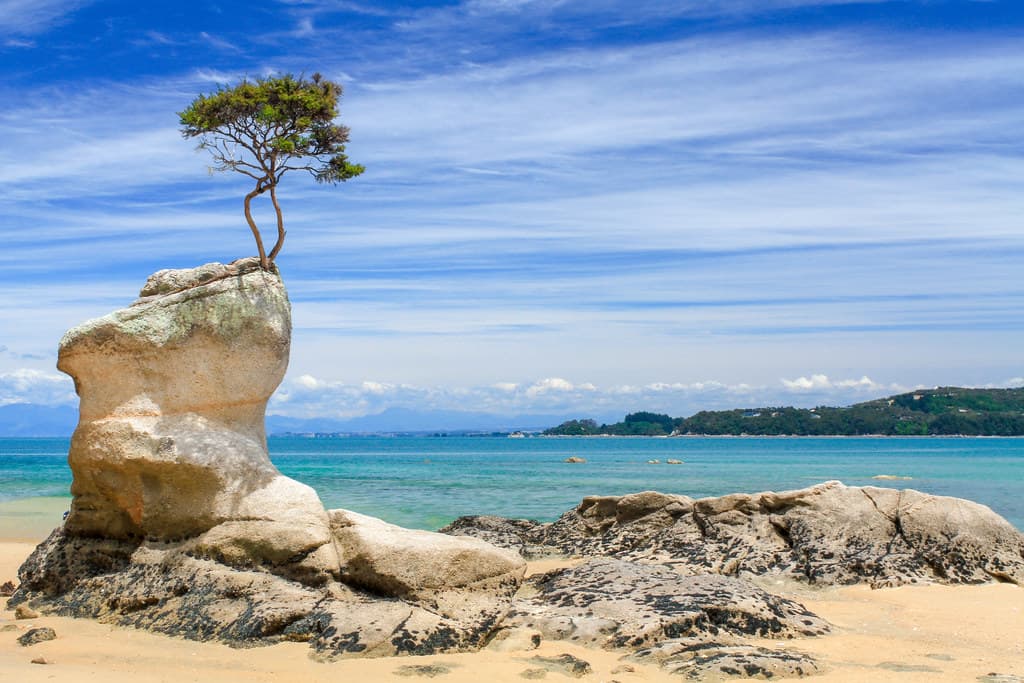
The bay announces itself through gaps in the canopy—a flash of turquoise water, then suddenly you're standing on a small crescent of sand flanked by granite boulders the size of cars. The beach is perhaps thirty meters wide, its sand mixed with smooth pebbles that clack underfoot like ceramic. Water the color of pale tourmaline laps at the shore, clear enough to count the ribs of sand beneath small waves.
Boulders scattered across the sand create natural windbreaks and privacy screens, their surfaces warm by midday and pocked with holes where the sea has worked the stone for centuries. Pohutukawa lean from the rocks at the bay's edges, their roots gripping stone cracks and their branches providing narrow bands of shade. The cove faces northwest, protected from southerlies but open to afternoon sun that heats the sheltered corners like natural solariums.
 Credit: Unsplash
a sandy beach next to the ocean under a blue sky
 Credit: Unsplash
a beach with boats on it
Protected warm pockets form
Smooth granite, full exposure
Seabed detail, rich color
Prime Visitation
Best Weather|Less Crowds
Where it is
Ngaio Bay
Kaiteriteri, Tasman, New Zealand
-41.022300°, 173.018100°
Weather
Loading…
Swell
—
Temp
Warm · Restorative
UV Index
Moderate
Wind
—
Tidal State
Last known
Max Sunlight
—
Ideal Shade
—
Jan - Dec (Peak)
Mar - Nov (Off-season)
Best Weather|Less Crowds
Select a category to load nearby places.
Unlock restaurants, luxury stays and curated maritime experiences within 2km
Ngaio Bay offers generally safe swimming conditions with clear, calm waters, especially during summer months. The sheltered cove provides natural protection from prevailing winds. However, there are no lifeguards on duty, so swim at your own risk and never alone. The rocky shoreline requires care when entering the water—water shoes are recommended. Conditions are best during high tide when the bay fills completely. Always check weather forecasts and be mindful of boat traffic, as the area is accessible by kayak and water taxis.
Visit Ngaio Bay during shoulder seasons (October-November or March-April) for the best combination of good weather and fewer visitors. Weekdays are significantly quieter than weekends, even in peak summer. Early mornings before 10am offer the most solitude. The bay is a local favourite precisely because it sees fewer crowds than nearby Kaiteriteri Beach, but July-August sees the fewest visitors overall, though swimming is less appealing in winter. Mid-week visits outside school holidays guarantee a peaceful experience.
Ngaio Bay is accessible by a coastal walking track from Kaiteriteri Beach, approximately 20-30 minutes on foot heading north. The track is moderately easy but involves some inclines and uneven terrain, so wear sturdy footwear. Alternatively, water taxis and kayaks can reach the bay from Kaiteriteri, though most visitors walk. There's limited parking at Kaiteriteri, especially in summer, so arrive early. The walk offers scenic coastal views. No vehicle access goes directly to Ngaio Bay, making it more secluded than the main beach.
Ngaio Bay has no facilities, cafes, or accommodation directly on-site, contributing to its unspoiled character. Bring all food, water, and supplies with you. The nearest amenities are at Kaiteriteri village (20-minute walk), which offers cafes, restaurants, a general store, and various accommodation options including motels, holiday parks, and rental properties. Pack snacks, sun protection, and plenty of drinking water for your visit. There are no toilets at Ngaio Bay itself, so use facilities at Kaiteriteri before walking over.
Unlike the busy, amenity-rich Kaiteriteri Beach, Ngaio Bay offers seclusion and tranquility with no commercial development. The intimate cove setting provides clear, calm waters ideal for couples and those seeking a peaceful sunbathing spot. The walk required to reach it naturally limits visitor numbers. The bay's golden sand and rocky outcrops create excellent snorkeling opportunities. It feels like a hidden gem despite being close to a popular tourist area. The lack of facilities means you'll experience the coastline in a more natural, undisturbed state.
Photos